Home » Virtual Staging for Empty Homes That Sells
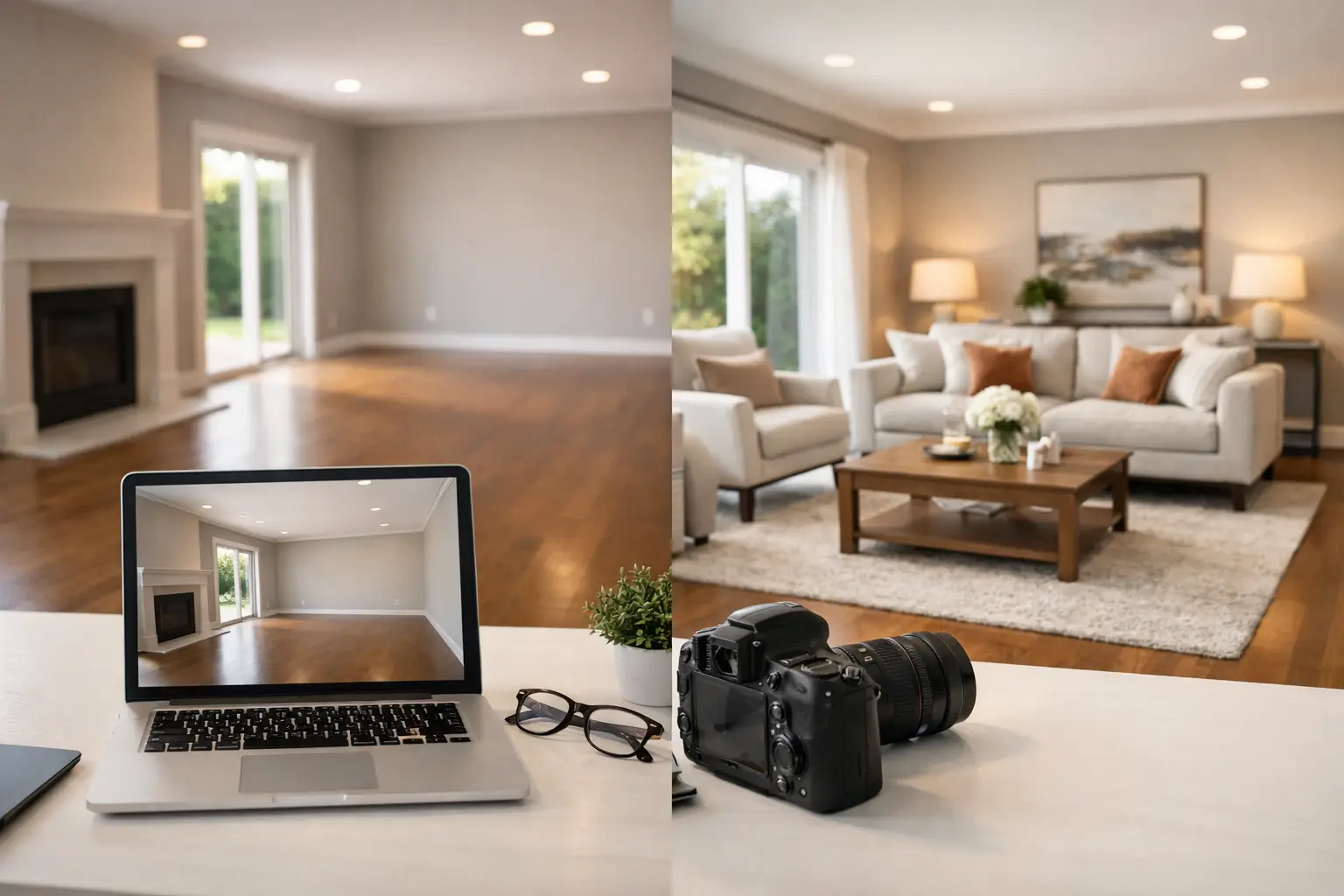
Virtual Staging for Empty Homes That Sells
An empty plot house or newly finished flat can photograph beautifully and still feel hard to sell. Buyers do not always struggle with the quality of the property itself. More often, they struggle with scale, purpose and atmosphere. That is where virtual staging for empty homes becomes commercially useful – not as decoration, but as a strategic way to help people picture how a space could work.
For developers, estate agents and marketing teams, that distinction matters. The goal is not simply to make a room look attractive. It is to reduce hesitation, strengthen first impressions and present an empty property in a way that feels considered, realistic and market-ready.
Why empty homes are harder to market than they should be
A vacant interior tends to flatten in photography. Without furniture, styling or visual cues, even well-proportioned rooms can appear smaller, colder or less practical than they are in person. Open-plan areas can feel undefined. Spare bedrooms can look awkward. Large reception spaces can lose their sense of scale altogether.
This creates a familiar problem in property marketing. A buyer or investor scrolls through a listing quickly, makes a judgement in seconds and moves on. If the imagery does not help them understand the potential of the home, the property has to work much harder elsewhere in the sales process.
That is particularly relevant for new-build developments, refurbished stock and empty rental properties. In each case, the home may be clean, complete and ready, yet still visually underperform. Strong staging solves the communication gap between a bare room and a lived-in idea of home.
What virtual staging for empty homes actually does
At its best, virtual staging adds context rather than clutter. It places carefully chosen furnishings, lighting, accessories and styling into professionally photographed empty rooms, creating photorealistic visuals that show how the property could be used.
The key word is could. Effective staging should feel believable for the property, the price point and the intended buyer. A compact city-centre flat needs a different approach from a four-bedroom family home or a premium waterside flat. Style has to support the sales narrative.
Done properly, virtual staging for empty homes helps answer practical questions buyers often ask subconsciously. Will a dining table fit here? Could this bedroom accommodate storage? Does this living area feel relaxed or cramped? Is this home suited to professionals, downsizers or families? The right visual treatment gives those questions an immediate, reassuring answer.
Why business clients are choosing virtual over physical staging
Physical show homes still have value, especially on larger schemes, but they are not always the most efficient option for every property or every phase of a campaign. Virtual staging offers a different commercial advantage. It is faster to roll out, easier to adapt and usually far more cost-effective across multiple units.
For developers marketing several plots, this matters. Rather than furnishing numerous units to a physical standard, teams can create consistent visuals across selected house types and use them in listings, brochures, sales presentations and wider campaign materials. Estate agents also benefit when a vacant resale property needs stronger online presentation without the cost and logistics of installed furniture.
There is also a timing advantage. Marketing often needs to move quickly, particularly when stock is ready, launches are approaching or listings need refreshing. Virtual staging allows a property to be elevated without waiting for furniture hire, access arrangements and on-site installation.
That said, it is not always an either-or decision. Some developments benefit from one physical show unit supported by virtually staged imagery for additional plots. In other cases, virtual staging is the most practical route from the outset. The right choice depends on budget, sales strategy and how the asset will be marketed.
The difference between convincing staging and obvious staging
Not all virtual staging achieves the same result. Buyers are increasingly familiar with digitally enhanced property imagery, so poor execution stands out quickly. If furniture floats, proportions feel wrong or lighting does not match the room, trust is weakened rather than strengthened.
Convincing work starts with accurate photography and a proper understanding of perspective, scale and interior styling. Furniture needs to sit naturally within the room. Materials should respond to the light source correctly. Soft furnishings, artwork and accessories must support the scheme without distracting from the architecture.
There is a marketing judgement involved too. Over-staging can be as unhelpful as no staging at all. If every room is packed with trend-led furniture, the property may feel less spacious and less flexible. The strongest visuals usually show restraint. They define the use of space, support the lifestyle message and leave enough room for the buyer’s imagination.
Where virtual staging has the biggest impact
The most obvious use is in residential sales, but the benefit is wider than that. Empty homes at different stages of the property cycle can all gain from a stronger visual treatment.
For house builders, staged CGIs and enhanced photography help standard house types feel distinctive and saleable before or just after completion. For estate agents, they can improve listing performance where a vacant property lacks warmth. For developers and investors, they support off-plan marketing, reconfigured layouts and refurbished stock where the finished shell needs context.
There is also a brand benefit. When visual assets are handled consistently across photography, brochures, floor plans and sales collateral, the development feels more credible. That coherence matters to commercial buyers because presentation does not operate in isolation. The image style, the brochure, the signage and the wider campaign all shape perceived value.
This is where a studio model becomes especially useful. When CGI and graphic design sit together, visual choices are made with the whole campaign in mind rather than one asset at a time.
How to brief virtual staging for empty homes well
The quality of the brief has a direct effect on the quality of the outcome. Clients usually get the best results when they begin with the buyer profile rather than a preferred furniture trend. A first-time buyer flat, an executive rental and a family-focused new build should not be dressed in the same visual language.
Room function should also be clear from the outset. If the property includes a flexible room, decide whether it is being marketed as a home office, nursery, second reception room or guest bedroom. Ambiguity in the property may be real, but ambiguity in the imagery can weaken the message.
It also helps to define where the images will be used. Portal listings, printed brochures, social media campaigns and sales-suite displays all place slightly different demands on composition and detail. A commercially focused studio will consider not only how the image looks in isolation, but how it performs across the full set of marketing outputs.
Common concerns clients have – and when they are valid
Some clients worry that virtual staging could be seen as misleading. That concern is reasonable, but the issue is usually not the technique itself. It is whether the imagery represents the property honestly. If dimensions, architectural features and room layouts are shown accurately, staged visuals are simply helping viewers interpret the space.
Another concern is style dating too quickly. This can happen if the interiors lean too heavily into short-lived trends. A more durable approach tends to work better, particularly for developments marketed over a longer period. Clean, contemporary schemes with balanced styling generally retain their value longer than highly fashionable looks.
There is also the question of return on investment. Not every property needs extensive staging, and not every room needs equal attention. In many cases, the greatest impact comes from prioritising the principal bedroom, living area and kitchen-diner. A measured approach often delivers stronger value than trying to stage every corner.
What good staging says about the property and the brand behind it
When a vacant property is presented well, the message goes beyond the room itself. It suggests that the developer, agent or marketing team has thought carefully about buyer experience. It signals quality control, attention to detail and a clear sales strategy.
For that reason, virtual staging should not be treated as a quick visual fix. It works best when it sits within a broader presentation standard – photography, CGI, floor plans, brochures and branded materials all moving in the same direction. At TDR Creative, that joined-up approach is often what gives marketing its edge. The visuals are not created simply to fill space. They are built to support commercial decisions.
Empty homes do not need exaggeration. They need interpretation. When virtual staging is handled with precision, realism and a proper understanding of the target buyer, it helps a property feel easier to read, easier to remember and, ultimately, easier to sell.
