Home » Virtual Staging vs Physical Staging: Which Works?
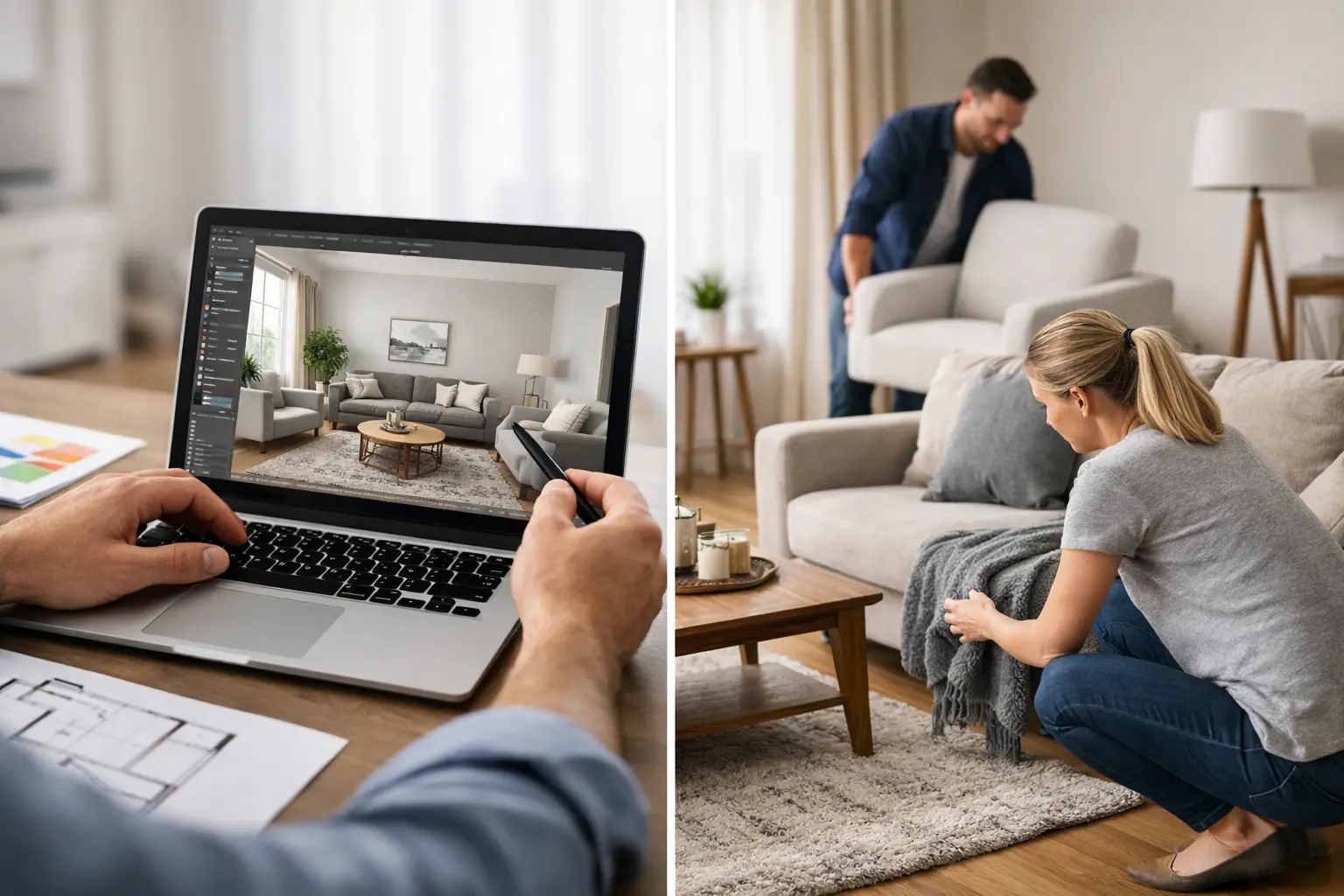
Virtual Staging vs Physical Staging: Which Works?
An empty new-build lounge can look generous on a floor plan yet feel unexpectedly difficult to read in a viewing. Equally, a beautifully dressed show home can create an immediate emotional response, but requires budget, access and careful coordination. That is why the choice between virtual staging vs physical staging is not simply about appearance. It is a commercial decision about how a property will be marketed, who needs to be persuaded and when the campaign needs to go live.
For developers, estate agents, architects and marketing teams, both approaches can help buyers understand scale, purpose and potential. The stronger option depends on the property, the sales strategy and the point the scheme has reached.
What each approach delivers
Physical staging places real furniture, furnishings, artwork and accessories in a completed property. It is most often used for show homes, premium resale properties and developments where in-person viewings are central to the sales process. The result is a tactile, fully dressed environment that visitors can walk through and experience first-hand.
Virtual staging uses CGI to add furniture, finishes and lifestyle detail to photographs or computer-generated property imagery. A vacant room can be presented as a considered living space, while an unfinished or unbuilt interior can be visualised before furniture could physically enter it. The final images are used across property portals, brochures, social campaigns, sales presentations and launch materials.
Both methods solve the same problem: empty spaces rarely communicate how people might live, work or relax there. However, they do so at very different speeds, costs and levels of flexibility.
Virtual staging vs physical staging: the commercial comparison
Cost and scalability
Physical staging involves furniture hire, styling, delivery, installation, insurance, removals and, often, an ongoing rental period. For a single flagship show home, that investment may be justified. It creates a valuable on-site sales tool and can support premium positioning where the physical experience is part of the proposition.
The cost rises quickly when several properties need dressing, layouts change or a campaign covers multiple house types. There are practical considerations too: furniture must be available, rooms must be accessible and installation has to work around construction schedules, cleaning teams and viewings.
Virtual staging is generally more cost-effective where the requirement is image-led marketing. Once the base photography or CGI view is approved, a studio can create multiple staged versions without the logistical cost of furnishing each property. This is particularly useful for flat schemes, build-to-rent developments and multi-unit launches, where the same unit type may need different visual treatments for different audiences.
The key distinction is that virtual staging creates a marketing asset, whereas physical staging creates an environment. If buyers will make their decision largely online before requesting a viewing, high-quality staged imagery can provide significant value for a more controlled budget.
Speed and campaign timing
Marketing programmes rarely wait for ideal site conditions. A development may need to launch before practical completion, while an estate agent may need photography turned around quickly after a property becomes vacant.
Virtual staging is well suited to these moments. It can be applied to vacant-room photography once the property is photographable, or incorporated into interior CGI while a scheme is still on the drawing board. There is no need to wait for deliveries, coordinate access for installers or keep furniture in place throughout a long sales period.
Physical staging needs more lead time and site readiness. That does not make it slower by default – experienced staging providers can work efficiently – but it introduces dependencies that a CGI workflow does not have. A delayed handover, restricted access or unfinished snagging can affect the installation date.
For pre-launch activity, virtual staging has a clear advantage. It allows sales teams to begin building interest with polished, believable interiors well before the first home is ready for a viewing.
Buyer experience and trust
Physical staging has one benefit that digital imagery cannot replicate: people can stand in the room. They can test circulation, see the view from the sofa position and understand how daylight moves through the space. For buyers visiting a show home, this sensory experience can reduce uncertainty and give a development a more established feel.
Virtual staging is strongest at the discovery stage, when a buyer is scrolling through listings, reviewing a brochure or comparing options on a portal. It helps a room earn attention and makes the purpose of awkward, compact or open-plan spaces instantly clearer. A spare room can become a credible home office; a large reception area can show distinct zones for dining and relaxation.
Trust depends on how the imagery is used. Virtual staging should be photorealistic, proportionate to the actual room and clearly presented as a visualisation where appropriate. It should not disguise structural defects, conceal poor condition or imply that furniture is included in the sale. Used responsibly, it is not misleading – it is a clear, effective way to communicate potential.
Creative control and brand consistency
A staged interior does more than fill a room. It signals a lifestyle, price point and audience. A city-centre rental scheme may need a contemporary, practical look; a family development may call for warmth, storage cues and a more relaxed palette; a high-value penthouse may demand restrained, design-led styling.
With virtual staging, that direction can be shaped with considerable precision. Furniture can be selected to suit the target buyer, colours can align with a campaign identity and styling can remain consistent across exterior CGI, brochures, site plans and digital advertising. Alternative looks can also be tested without replacing a single physical item.
Physical staging has its own authenticity, but options can be constrained by available stock, room access and the cost of changing the scheme. This is less of an issue when the objective is one memorable show home. It becomes more significant when a marketing team needs a broad suite of coordinated assets for a development with several unit types.
When physical staging is worth the investment
Physical staging is often the right choice when the property is complete, viewings are frequent and the sales environment itself needs to work hard. A flagship show home, a luxury residence or a slow-moving vacant property can benefit from the confidence that a well-furnished space brings.
It is also valuable where room scale is likely to be challenged. A buyer may understand a one-bedroom flat more readily when they can physically see a bed, dining table and sofa sitting comfortably in place. For developments with a dedicated sales suite, physical staging can support conversations that started online and help convert interest into commitment.
The strongest physical schemes are not decorative afterthoughts. They are planned around the target market, the architecture and the commercial positioning of the development.
When virtual staging is the better fit
Virtual staging is particularly effective for vacant properties that photograph well but lack warmth, for incomplete schemes requiring early marketing, and for developments that need a consistent campaign before every unit is available. It is also a practical choice where furniture hire would erode margin or where access makes installation difficult.
It can give estate agents more than one route to market a property. The same empty room may be visualised as a home office for professional buyers, a nursery for young families or a reading room for downsizers, provided the alternatives are used transparently. This flexibility helps marketing teams tailor messages without altering the property itself.
For architects and developers, virtual staging can be part of a wider visualisation programme rather than a standalone service. Interior CGI, exterior views, floor plans, animation and printed sales collateral can be developed from a shared visual direction. That consistency matters: a buyer should recognise the same level of quality from the first digital advert through to the brochure and the eventual viewing.
The most effective approach is often both
Virtual and physical staging do not need to compete. A development may use virtual staging to launch early, generate enquiries and market multiple unit types, then invest in one physical show home once construction and viewings permit. The digital work establishes the campaign; the real space gives buyers a final point of reassurance.
This combination can be especially effective for phased developments. CGI-led visuals maintain momentum while later plots are under construction, while the show home provides a tangible expression of the brand and specification. The visual language should match closely, so the property shown online feels connected to the one buyers visit.
Questions to answer before choosing
Before committing budget, consider where buyers make their first decision, how soon the campaign must begin and whether the property needs to sell an experience or simply explain a space. Also consider the number of units involved, the likelihood of design changes and whether the visual assets will need to work across brochures, portals, social content and sales presentations.
If the priority is fast, flexible, polished marketing across several properties, virtual staging will usually deliver more reach per pound spent. If the priority is a high-impact physical viewing environment, physical staging may be the stronger investment. Where the programme allows, combining both provides the widest coverage.
The best staging choice is the one that makes a buyer feel they understand the property before uncertainty has a chance to slow the sale. Plan it early, brief it against the target market and make every image or room work towards the same commercial outcome.
