Home » Top Brochure Ideas for Developments That Sell
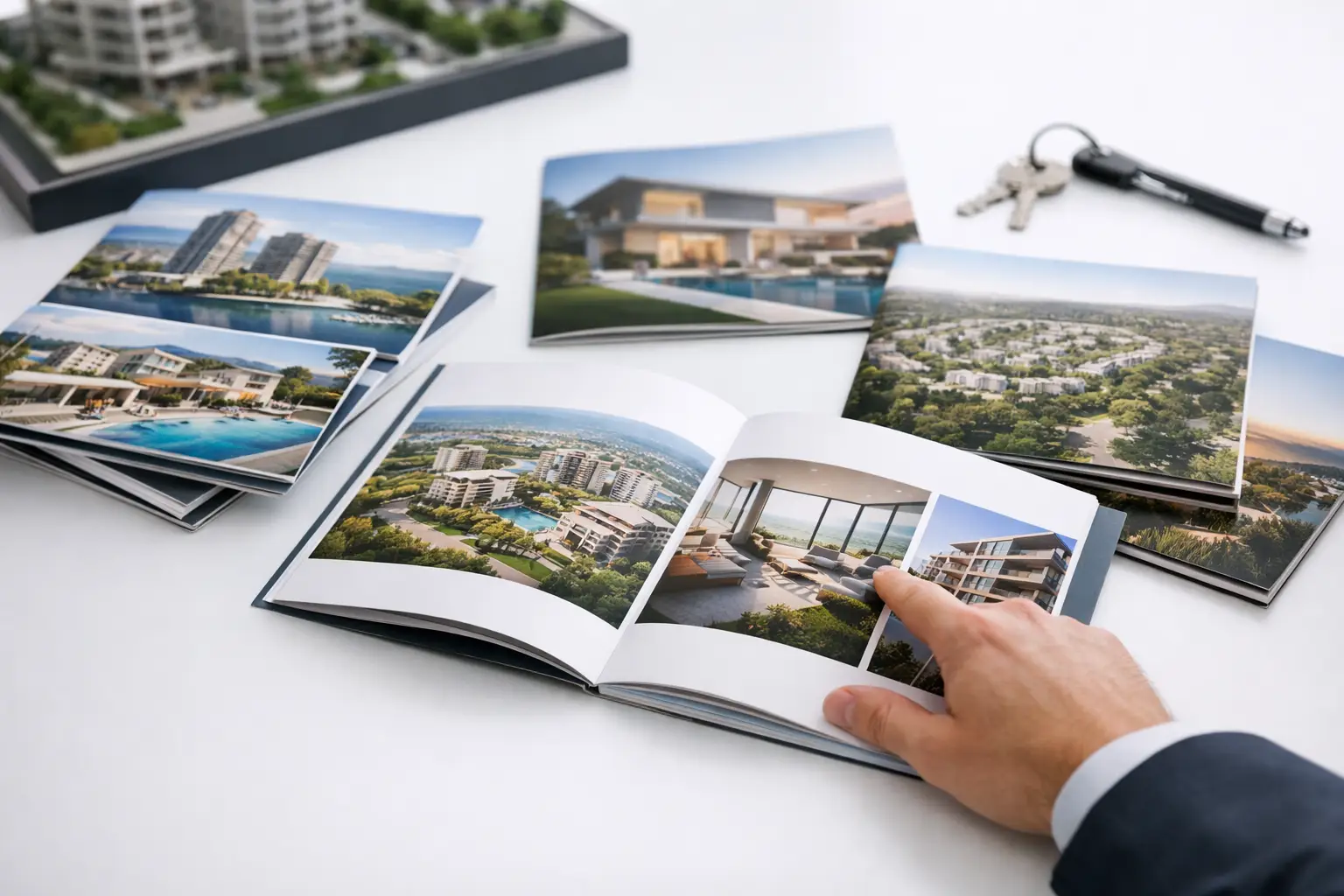
Top Brochure Ideas for Developments That Sell
A development brochure has to sell a place before many buyers can physically experience it. That is why the top brochure ideas for developments do more than present a schedule of accommodation: they make the proposition tangible, explain the lifestyle on offer and give sales teams a confident, consistent tool to use from launch through to completion.
For house builders, developers and agents, the strongest brochures combine commercial clarity with carefully considered visual storytelling. They answer the questions a buyer may not voice immediately: What will it feel like to live here? How does this home compare? What makes the location worth choosing? And, crucially, can I picture myself making a decision now?
Start with the buying decision, not the page count
A brochure should be designed around the way a development is sold, rather than around a fixed number of pages. A scheme aimed at first-time buyers may need to establish affordability, connectivity and practical layouts quickly. A premium collection of flats may need more space for architecture, materiality, concierge-style amenities and the character of the surrounding neighbourhood.
The useful question is not, ‘How many pages should our brochure have?’ It is, ‘What does a prospective buyer need to see to move to the next conversation?’ This keeps content focused and prevents the common problem of a handsome brochure that says very little.
Before design begins, establish the audience, price position, sales route and stage of the build. Off-plan launches require persuasive CGI and clear reassurance around specification. A nearly completed development can benefit from photography, progress imagery and practical move-in information. The balance changes, but the underlying job remains the same: turn interest into confidence.
Top brochure ideas for developments with a clear sales role
Lead with one memorable development story
Every scheme needs a central idea that holds the brochure together. It may be city-centre convenience, family living near green space, warehouse-inspired character or a considered response to a historic setting. This is not a slogan added at the end. It should shape the photography, CGI, type, colour palette and copy throughout.
A clear story also helps distinguish one development from another when buyers are comparing several options online or in a sales suite. Rather than opening with a generic statement about luxury, identify the specific quality that is difficult to replicate. Perhaps it is a landscaped courtyard, views across the city, carefully selected brickwork or access to a rail station within walking distance.
Make the opening spread work hard. A striking exterior CGI, an informed headline and a short introduction can establish both aspiration and credibility without overloading the reader with claims.
Use CGI to show the experience, not simply the building
Exterior visualisation is essential for unbuilt developments, but a single front elevation rarely carries the full story. Buyers need to understand arrival, scale, setting and the relationship between homes, landscaping and local streets. Consider a mix of hero imagery, closer architectural details and contextual views that show how the scheme sits within its surroundings.
Interior CGI should be equally selective. A well-composed kitchen-living space, principal bedroom or roof terrace can establish the standard of finish far more effectively than a sequence of near-identical rooms. The aim is to show desirable moments of daily life while remaining faithful to the actual specification.
Accuracy matters. CGI that looks impressive but misrepresents a view, finish or spatial relationship creates problems later for sales teams and purchasers. The best visualisations blend creativity with precision, using approved plans, material references and architectural information as the foundation.
Let floor plans do their commercial job
Floor plans are often treated as technical inserts, yet they can be among the most consulted pages in a brochure. They should be easy to read, consistently styled and clearly connected to flat or house types, dimensions and key features.
Avoid shrinking plans until labels become difficult to decipher. If a development has numerous variants, group plans logically by building, bedroom count or collection. Add simple furniture layouts where appropriate, as they help buyers judge how a room may function. For larger schemes, an annotated site plan can also explain orientation, parking, green space, entrances and plots at a glance.
There is a trade-off here. Decorative plans may look on-brand but lose practical clarity; highly technical drawings can feel cold and inaccessible. A good brochure finds the middle ground, with accurate information presented in a polished, buyer-friendly format.
Turn location into a reason to act
A location page should not be a scatter of local logos and travel times. It needs to explain why the setting improves the buyer’s everyday life. For an urban development, that may mean independent food, culture, commuting routes and walkability. For a suburban or semi-rural scheme, it may be schools, open space, village amenities and access to major employment centres.
An illustrated map is often more engaging than a standard road map because it can prioritise the places that matter to the audience. Pair it with concise editorial copy and a small number of useful journey times. Be precise about whether timings are walking, driving or rail-based, and avoid making the page feel like a directory.
For investor-focused material, location content may also need to address rental demand, regeneration, employment or transport investment. That requires a more factual tone and should be supported by information that can be substantiated.
Make specification feel considered
A specification page is where promise becomes proof. Instead of presenting a dense block of product names, organise the details into logical categories such as kitchens, bathrooms, lighting, security, energy performance and external areas. This makes the quality of the offer easier to assess.
Material close-ups, finish boards and carefully chosen detail CGI can give this section real presence. They are particularly valuable where buyers cannot yet view a finished show home. However, presentation must remain aligned with the contractual specification. If a finish is indicative, state that clearly rather than leaving scope for confusion.
For higher-value homes, a separate finishes spread can be worthwhile. For entry-level flats, the same information may work better as a concise, well-designed page. The level of detail should reflect the decision being made.
Give sales teams pages they can use in conversation
The most effective brochure is not only a marketing piece. It is a practical sales asset. That means considering how it will be used in a meeting, emailed after an enquiry, displayed in a sales suite or printed for an agent’s pack.
Include a clear development overview, availability or collection structure where suitable, contact details and a concise next step. If prices and availability change frequently, avoid burying them in a large print run. A separate price list or insert gives greater flexibility and reduces waste.
Digital versions should receive the same care as print. Buyers may first encounter the brochure on a mobile phone or tablet, where tiny type, sprawling double-page spreads and heavy files can frustrate rather than persuade. A well-built digital PDF, with a thoughtful page sequence and legible content, is often all that is required. Interactive tours, animation and virtual staging can then extend the campaign where they genuinely support the sales journey.
Create one visual system across the launch
Brochure design is strongest when it is part of a coordinated campaign. The cover, hoarding, sales suite graphics, estate agent materials, social assets, CGI and presentation decks should feel like they belong to the same development. Consistency makes a scheme appear more established and gives every touchpoint greater cumulative impact.
This is where bringing CGI and graphic design together can make a practical difference. With one studio managing the visual language, imagery can be commissioned for specific layouts, plans can match the campaign identity and late-stage changes can be handled without weakening the overall look. TDR Creative approaches this as a connected production process, balancing presentation quality with dependable delivery.
Print choices also deserve early consideration. An uncoated stock can support a crafted, editorial feel; a heavier silk finish may better suit a polished urban scheme with rich CGI. Foil, embossing and unusual formats can add distinction, but only when they reinforce the development’s position. They should not become an expensive substitute for strong content and visual direction.
Build room for change without losing quality
Developments evolve. Specifications are refined, planning conditions change, plots sell and construction programmes move. A brochure should be designed with enough flexibility to accommodate likely updates without repeated, costly redesign.
Modular sections, replaceable inserts and a clear master artwork structure are sensible measures, particularly for phased schemes. They allow the brand and core story to remain stable while the practical sales information stays current. Early coordination between the developer, architect, sales team and creative partner reduces last-minute amendments and protects accuracy.
The final test is simple: place the brochure in the hands of someone who has not worked on the scheme. Can they understand what is being offered, why it is distinctive and what they should do next within a few minutes? If the answer is yes, the brochure is doing far more than looking good. It is helping the development earn attention, trust and enquiries before the first viewing takes place.
