Home » Virtual Tours for Commercial Spaces That Sell
Virtual Tours for Commercial Spaces That Sell
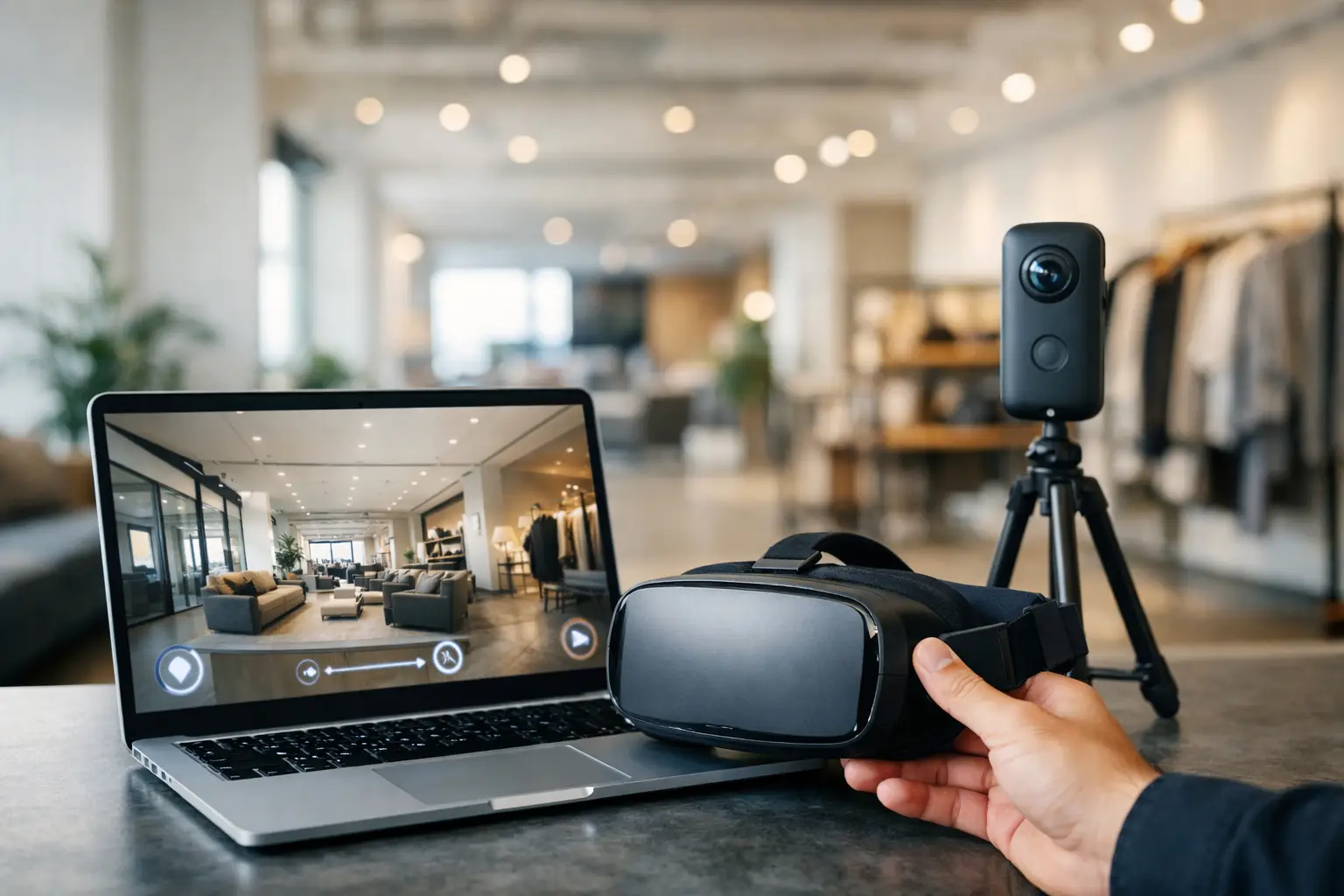
A vacant unit, an unfinished development or a workspace in another city asks a great deal of a prospective customer’s imagination. Static plans and photographs can explain the facts, but they rarely convey how a place feels to move through. Virtual tours for commercial spaces give buyers, occupiers and stakeholders a more immediate way to understand scale, flow, finish and potential – before a visit is possible, or before the space even exists.
For property, architecture, retail and workplace teams, that has a direct commercial benefit. A well-produced interactive tour can make an early-stage conversation more informed, qualify interest more effectively and give sales and marketing teams an asset they can use long after the launch campaign.
Why virtual tours for commercial spaces carry more weight
Commercial decisions are seldom made by one person. A potential occupier may need approval from directors, a facilities team, a brand manager and a finance lead. A developer may be presenting to agents, investors and prospective tenants at the same time. Each audience is looking for something slightly different, yet all need to understand the same place.
An interactive tour gives them a shared reference point. Rather than interpreting a floor plan separately or relying on a sales conversation, users can navigate key areas at their own pace. They can see the arrival experience, move between departments, compare meeting rooms or examine a proposed retail layout. It makes the proposition easier to circulate internally and easier to recall later.
This matters particularly where photography cannot yet do the job. CGI-led tours allow a scheme to be marketed during planning, construction or refurbishment, when the final environment is not available to capture. They can also show a unit in its best intended state rather than as an empty shell, incomplete fit-out or occupied space that is difficult to photograph.
The value is not simply novelty. The strongest tours reduce uncertainty. They answer practical questions visually: Where is the reception? How does the customer move from entrance to display area? Is there natural light in the workspace? What does the view from a principal office look like? When those answers are clear, conversations can move from basic orientation to genuine suitability.
The commercial applications that benefit most
Virtual tours are flexible, but they are most effective when they support a defined sales, leasing or communication objective. For a commercial development, the purpose may be to help agents market available units before practical completion. For a branded environment, it may be to demonstrate how an interior concept will work across a new location or estate.
Commercial property and mixed-use schemes
Office buildings, industrial parks, retail destinations and mixed-use developments often need to generate interest well before completion. A tour can bring proposed interiors, shared amenities, entrances and external context together in one clear experience. It gives prospective occupiers a stronger sense of what they are considering than a brochure spread alone.
There is a useful distinction here. A tour is not a substitute for accurate plans, specifications or a site visit. It is the visual bridge between them. When aligned with floor plans, CGI imagery and branded sales collateral, it helps turn technical information into a more persuasive proposition.
Retail, hospitality and leisure environments
In customer-facing settings, journey matters as much as square footage. Retailers and operators can use tours to demonstrate sightlines, zoning, display opportunities, seating areas and the relationship between front-of-house and service spaces. For hospitality, the ability to communicate atmosphere is especially valuable when an interior is still a concept rather than a finished venue.
The creative treatment should remain commercially grounded. Over-styled lighting or unrealistic activity may make an image look impressive, but it can weaken trust if the proposed environment feels implausible. The aim is aspiration with accuracy.
Workplaces, showrooms and brand spaces
For employers, a virtual walkthrough can support recruitment, internal engagement and relocation communications as well as property marketing. It allows teams to introduce a new workplace before move-in, explaining neighbourhoods, collaborative zones, quiet spaces and customer areas in a format staff can revisit.
For brands with showrooms or complex product environments, hotspots can provide further context without crowding the visual experience. The best use of these features is selective: a material detail, product range, sustainability credential or booking prompt where it genuinely helps the viewer decide what to do next.
What makes a tour strategically effective
A polished render alone does not automatically make a useful tour. Commercial impact comes from planning the experience around the audience, the key decision points and the wider campaign.
Start with the story the viewer needs to understand. An office tour might begin at the building approach, then establish the reception and shared facilities before moving into a fitted suite. A retail tour may prioritise the customer entrance, product journey and key branded moments. The route should feel intuitive, even when viewers are free to explore independently.
Visual quality is equally important. Materials, lighting, furniture, signage and proportions need to hold up when viewed from multiple angles. In CGI, small inaccuracies can become more obvious in an interactive environment because the user controls where they look. Careful modelling and considered art direction are therefore not decorative extras. They protect credibility.
Navigation also deserves restraint. Too many icons, pop-ups and route options can distract from the space itself. A clear starting point, straightforward controls and a limited number of purposeful information points will usually serve a commercial audience better than an interface designed to show off every available feature.
Finally, the tour should sit within a consistent visual system. If the CGI, brochure, floor plans, site plan, campaign graphics and sales presentation all look as though they belong to different projects, the overall proposition loses authority. Bringing these elements together through one creative process helps preserve brand consistency and saves the client from coordinating multiple suppliers.
Choosing between captured and CGI-led tours
The right production method depends on the stage and nature of the project. Captured 360-degree photography is often suitable for a completed office, venue, showroom or retail space where the objective is to show the real environment exactly as it is. It can be efficient and credible, particularly for active locations where a quick marketing asset is required.
CGI-led tours are better suited to unbuilt, refurbished or partially complete spaces. They give greater control over the proposed fit-out, lighting, landscaping, furnishing and brand expression. They are also useful where several design options need to be presented, or where an environment must be shown without the disruption of a photographic shoot.
There are trade-offs. CGI needs reliable source information, such as drawings, specifications, finishes schedules and design intent. Changes late in the process can affect programme and cost, especially where the tour covers a large scheme. Captured tours avoid some of that modelling work, but they cannot disguise an unfinished space or show a future vision.
A hybrid approach can be effective for phased developments: use CGI to market future spaces, then introduce photography as completed areas become available. The important point is to be clear about what the tour represents. If it is indicative, say so. Trust is strengthened when expectation and delivery match.
A better brief produces a better result
Before commissioning a virtual tour, establish who needs to use it, where it will appear and what action it should encourage. A tour intended for leasing agents needs a different emphasis from one built for investor presentations or consumer-facing marketing. The same is true of device use. Many people will first view it on a mobile, while others may explore it on a large screen during a pitch or sales appointment.
Provide the creative team with current drawings, intended finishes, key views, brand guidelines and any existing campaign assets. Agree the areas that matter most instead of trying to represent every square metre. A focused tour of the lobby, typical floorplate, amenities and available suite may be more useful than a vast model that leaves the viewer without direction.
It is also worth agreeing sign-off stages early. Review the visual style, camera positions, key materials and information points before the interactive build is finalised. This protects programme, keeps feedback constructive and ensures the finished asset reflects both the design intent and the commercial message.
At TDR Creative, CGI visualisation and graphic design are developed under one roof, allowing tours to work alongside the wider campaign rather than as a standalone technical exercise. That joined-up approach is particularly valuable when deadlines are tight and several marketing outputs must launch together.
Make the experience earn its place
A virtual tour should not be commissioned simply because competitors have one. It should earn its place by helping the right audience understand a commercial opportunity faster and with greater confidence. Used well, it gives an unbuilt scheme presence, gives distant decision-makers access, and gives a sales team a more compelling way to continue the conversation.
The most useful next step is not to ask how many features a tour can contain. Ask what a prospective buyer, tenant or customer needs to see before they are ready to take the next meaningful step. Build the experience around that answer, and the visual investment has a far better chance of delivering measurable value.
