Home » CGI Versus Property Photography for Developers
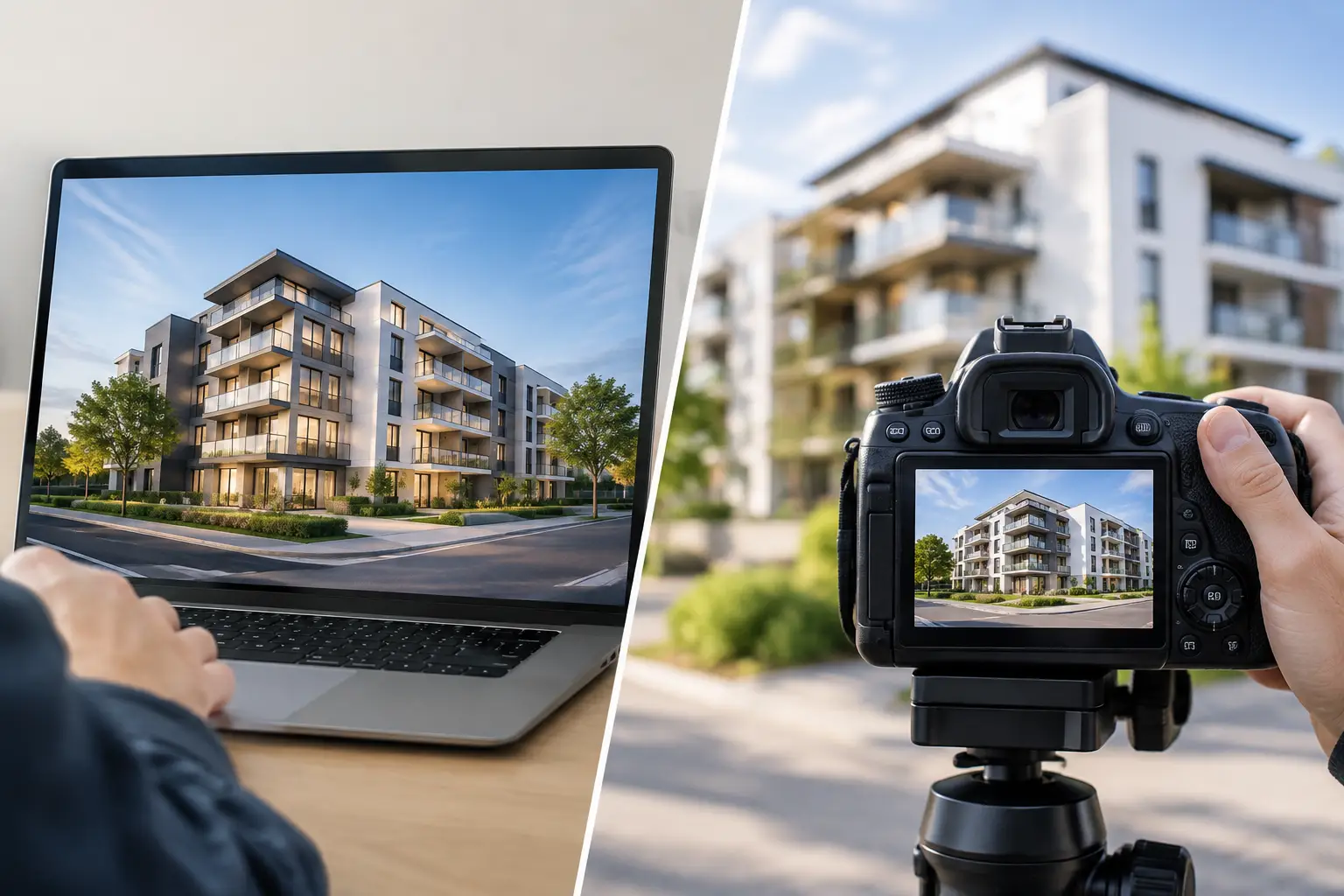
CGI Versus Property Photography for Developers
A sales launch rarely waits for perfect weather, finished landscaping or the final handover. That is why the choice between CGI versus property photography is not simply a question of visual style. It determines what a developer, architect or agent can show, when they can show it and how consistently the story carries across the campaign.
Photography records what is already there. CGI creates a precise, market-ready view of what is planned. Both can be highly effective, but they solve different commercial problems. Selecting the right approach starts with the status of the scheme, the audience’s questions and the assets required beyond a single hero image.
CGI versus property photography: the fundamental difference
Property photography works from a real, physical subject. It captures completed homes, refurbished spaces, show flats, streetscapes and details that prospective buyers or occupiers can visit. Its strength is evidence. A well-composed photograph can communicate genuine material quality, natural light and the atmosphere of a finished place with immediate credibility.
CGI visualisation begins with drawings, models, specifications and a brief. It can show an exterior before the first groundworks begin, furnish an empty flat, set a development in its intended landscape or illustrate a view from a future penthouse. The result is not a substitute for reality. It is a carefully controlled representation of the proposed reality, created to help audiences understand it before it exists.
This distinction matters because property marketing often has to work ahead of construction. If sales, planning communications, investor presentations or brochure production need to begin before practical completion, photography alone cannot provide the required material.
When property photography is the stronger choice
For a completed project, photography brings a sense of proof that no visualisation should try to imitate. Buyers can see the finished kitchen, the actual outlook, the quality of communal areas and the way daylight falls through the room. For estate agents marketing an existing home, that authenticity is central to the decision-making process.
Photography is also valuable after a development has launched from plan. It helps refresh sales collateral with completed imagery, supports case studies and provides useful content for social media, press activity and future portfolio work. A scheme may begin with CGI and gradually shift towards photography as phases complete.
There are limits. Photography depends on access, weather, season, site readiness and the condition of the spaces. A façade may be complete while roads, planting and neighbouring plots are still under construction. Internally, an empty unit can feel cold and difficult to read, while a show home may not reflect every house type available. Retouching can improve an image, but it cannot economically rebuild an incomplete environment.
Where CGI creates a commercial advantage
CGI gives project teams control over timing. An exterior image can be commissioned from approved architectural information, allowing marketing activity to begin while construction is underway. This is particularly useful for off-plan sales, public consultation, funding packs and launch campaigns where interest must be built early.
It also gives control over the message. A visual can show the selected house type, a considered furniture scheme, appropriate seasonal planting and the intended level of activity around the development. For an interior, virtual staging can make scale, layout and potential much easier to understand without the cost and logistics of dressing multiple physical units.
That control is valuable, but it must be used responsibly. A strong CGI is detailed, proportionate and aligned with the current design information. It should make the proposition clear, not create expectations that the development team cannot fulfil. Accurate briefing, agreed materials and clear review stages protect both visual quality and commercial confidence.
CGI can also work harder across a campaign. A set of approved models and materials can support still imagery, animated sequences, 360-degree tours, site plans, floor plans and brochure artwork. When the same creative team manages these outputs, the development retains a coherent visual language from the first teaser through to sales documentation.
Cost is about reuse, not only the first image
It is tempting to compare a photographer’s day rate with the cost of a CGI image and make a quick decision. In practice, the useful comparison is broader. Photography may be more economical when a finished property is ready, accessible and requires a straightforward set of images. CGI can offer better value when it avoids repeated site visits, physical staging, weather delays or the need to wait for works to finish.
Reuse changes the equation further. A CGI model can often be adapted for different viewpoints, house types, lighting conditions and campaign formats, provided the underlying design is stable. Photography is less flexible: a new angle, revised finish or changed landscape usually requires another shoot.
Neither route is automatically cheaper. A highly detailed CGI with extensive modelling, bespoke landscaping and multiple review rounds requires proper budget. Equally, a complex photography brief involving several locations, styling, retouching and restricted access can become substantial. The right investment depends on the number of assets needed, the programme and how long the visuals must remain useful.
A hybrid approach often delivers the best campaign
For many developments, CGI versus property photography is the wrong either-or question. The strongest campaigns use each medium at the point where it has most impact.
Before completion, CGI can establish the vision: the entrance, key street scenes, aspirational interiors and lifestyle-led marketing imagery. Once show homes and shared spaces are ready, photography can introduce tangible proof. Later, completed exteriors, residents’ amenities and local-area content can add further confidence.
This progression feels natural to a buyer. Early visuals help them imagine the opportunity; later photography reassures them that the promise has been delivered. It also gives marketing teams a rolling supply of content rather than one short burst around launch.
The same principle applies to architectural practices and commercial property teams. A planning visual may need clarity and contextual accuracy, while an investor brochure may need a more polished, brand-led image of the finished offer. The base information can be shared, but the visual purpose should guide the final treatment.
How to choose the right visual for the brief
Start with the question the image must answer. If the audience needs to know what is already built and available to view, photography is usually the correct lead asset. If they need to understand a future space, an unbuilt elevation or the potential of an unfinished unit, CGI is likely to be more useful.
Then consider programme. Ask whether the asset is needed before a site can be photographed properly, and whether the design is sufficiently signed off to visualise with confidence. CGI is most efficient when architectural decisions, material palettes and landscape intent are clear. Frequent late changes are possible to accommodate, but they should be planned into the project rather than treated as an afterthought.
Finally, look at the full marketing system. A single photograph or render rarely works alone. It may need to sit alongside floor plans, sales brochures, display graphics, digital adverts, signage and presentation material. Bringing visualisation and graphic design together helps protect consistency in colour, messaging, image treatment and brand application. For clients who need one coordinated process, TDR Creative can develop these assets as part of a joined-up creative brief.
Briefing for imagery that stands up to scrutiny
The quality of the final result is often decided before production begins. Supply the latest drawings, elevations, site plan, finishes schedule and any relevant reference imagery. Be clear about the intended audience, key selling points and where the visuals will appear. An image for a planning consultation needs a different balance from one designed to sell a premium two-bedroom flat.
It is also worth agreeing what must be exact and what can be interpretive. Architecture, views, materials and key landscape features may require strict accuracy. Furniture, styling, sky conditions and the level of human activity may be used more creatively to support the desired tone. Establishing those boundaries early reduces revisions and keeps the work commercially focused.
The best property imagery does more than make a scheme look attractive. It makes the right aspects of the scheme easy to understand, credible to believe and compelling to act on. Choose photography when reality is your strongest evidence, CGI when the future needs to be seen, and a considered combination when the campaign must carry confidence from first release to final completion.
