Home » Virtual Tour Versus Showroom: Which Sells Better?
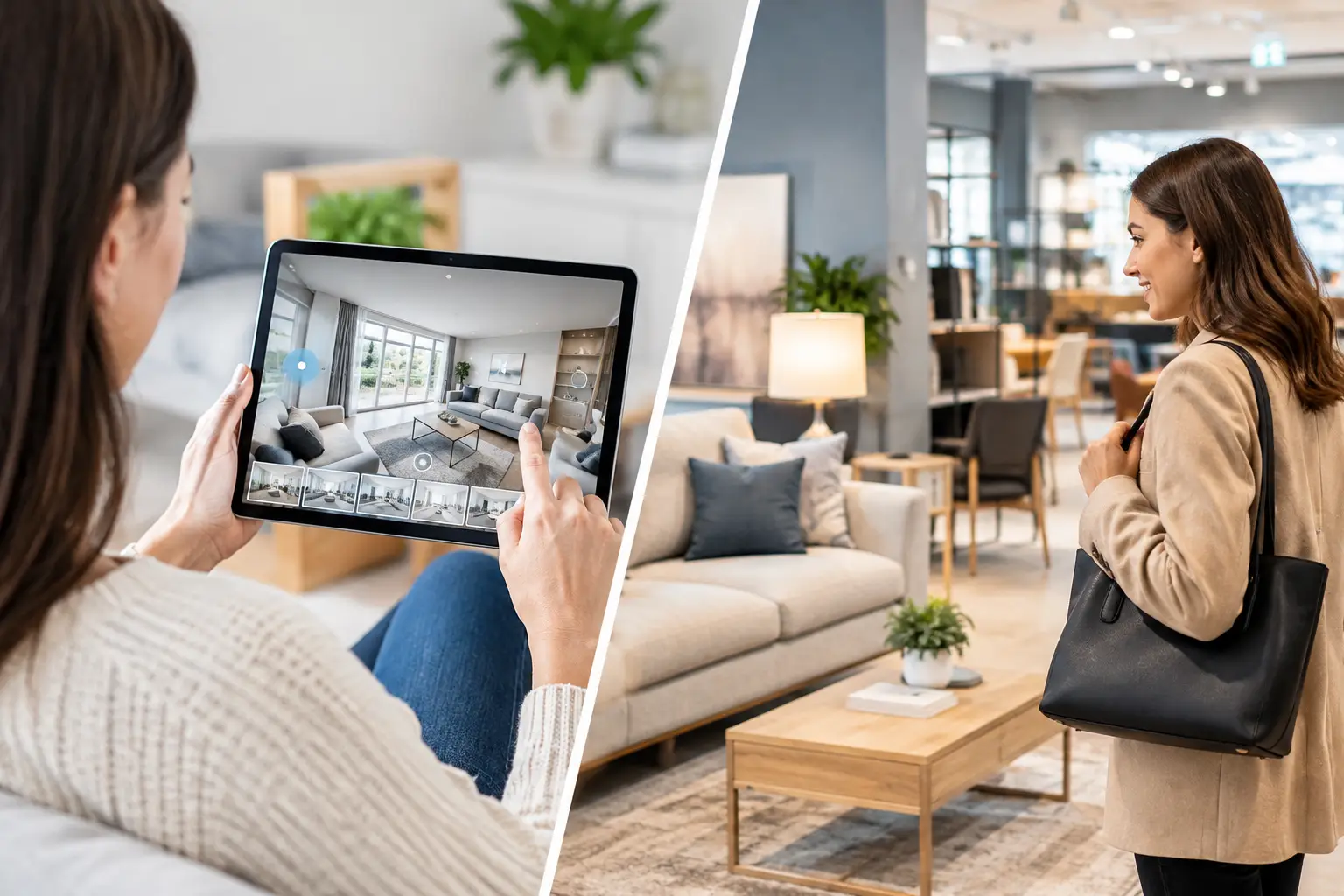
Virtual Tour Versus Showroom: Which Sells Better?
A buyer may first encounter a development from their kitchen table at 9pm, then make a decision worth hundreds of thousands of pounds after a Saturday viewing. That is the real context for the virtual tour versus showroom question. It is not simply a choice between digital and physical marketing. It is a decision about how to build interest, answer objections and give people enough confidence to take the next step.
For property developers, house builders, architects and sales teams, the strongest answer is rarely an either-or. A carefully produced 360° virtual tour and a well-considered showroom solve different parts of the buyer journey. The right balance depends on the stage of the scheme, the type of purchaser, the number of units available and the sales objective.
Virtual tour versus showroom: the core difference
A virtual tour is a scalable sales and marketing tool. It allows prospects to explore a space remotely, revisit it when convenient and share it with decision-makers who may not attend an initial viewing. When built from accurate CGI, it can bring an off-plan home, commercial interior or unbuilt development to life long before physical completion.
A showroom, sales suite or show home is an in-person confidence builder. It gives visitors a physical sense of material quality, spatial scale, light, finishes and location. It also creates a controlled setting for conversations that can move a prospect closer to reservation.
The distinction matters because the two formats create value differently. A virtual tour extends reach and keeps a development visible around the clock. A showroom creates emotional connection through real-world presence. Treating one as a cheap substitute for the other can leave gaps in the customer experience.
What a virtual tour does particularly well
The commercial advantage of a virtual tour is access. Buyers can view before travelling, compare layouts with a partner or family member, and return to the experience after speaking to a mortgage adviser. For overseas purchasers, busy professionals and buyers relocating from another part of the UK, this can remove a substantial barrier to early engagement.
It is especially useful during pre-launch and construction. A physical sales environment may not yet exist, while a development still needs to generate enquiries, support agent conversations and build a pipeline. High-quality CGI allows the tour to show the intended finish rather than a partially constructed shell. The result should not be a generic digital walkthrough, but an accurate visual representation that supports the sales proposition.
A tour can also make complex schemes easier to explain. Buyers can move through key rooms at their own pace, inspect kitchen and bathroom specifications, understand sightlines and view alternative flat types. For a mixed-use project or a development with several layouts, this is more practical than relying on a handful of still images alone.
From a marketing perspective, the content works hard. The same CGI assets may inform brochures, sales collateral, digital campaigns, floor plans and presentation materials. When one creative team manages the visual direction across these outputs, the development feels coherent at every touchpoint.
Where virtual tours need careful handling
Digital convenience does not automatically create buyer trust. A poor tour can do the opposite. Unrealistic lighting, vague details, awkward navigation or visual promises that are not supported by the final specification can raise questions rather than answer them.
Accuracy is therefore central. The architecture, room proportions, selected materials and proposed views need to be agreed early. If certain elements remain subject to change, the sales team should communicate this clearly. Photorealism has commercial value only when it is paired with disciplined information and credible expectations.
A virtual tour also cannot replicate every sensory judgement. A buyer may want to feel the texture of a worktop, assess acoustic privacy, judge ceiling height in person or understand how the building sits within its immediate surroundings. Those are meaningful limitations, not reasons to avoid the format.
Why showrooms still influence high-value decisions
A showroom remains valuable because property is experienced physically. Even an exceptional CGI visualisation cannot fully communicate the atmosphere of a finished space. The weight of a door, the quality of joinery, the daylight in a living area and the scale of a room all affect perception.
For premium developments, a well-designed sales suite signals care and confidence. It gives a development team a place to tell the story behind the scheme, display samples, present options and host focused appointments. The setting itself becomes part of the brand experience.
Showrooms are also effective when purchasers are choosing between specifications. Seeing flooring, cabinetry, tile ranges and hardware together can reduce uncertainty. This is particularly relevant where personalisation, upgrades or buyer incentives form part of the sales process.
There is a practical sales advantage too. In-person meetings allow teams to read hesitation and respond directly. A prospective buyer who lingers on a model, asks about storage or compares two finishes is giving useful information. An experienced sales consultant can then tailor the conversation in a way a self-guided tour cannot.
The cost and timing of a physical space
A showroom demands more than fit-out budget. It requires a suitable location, design and installation time, ongoing staffing, maintenance, utilities and a plan for how it will evolve as the development progresses. For smaller schemes, this can be disproportionate to the likely return.
Timing can also be restrictive. If the site is difficult to access during construction, or the target market is geographically dispersed, relying primarily on a physical sales suite may limit early momentum. A showroom is strongest when it is supported by clear digital material before and after each appointment.
Choosing the right approach for your development
The decision should begin with buyer behaviour rather than a preferred format. If your audience includes relocation buyers, investors or people with limited availability for viewings, a virtual tour is likely to have a major role. If the sale depends on premium finishes, bespoke upgrades or a highly tactile brand experience, a showroom deserves greater investment.
The size and sales programme of the scheme matter as well. A large development with phased releases may justify both from the outset. Digital content can create early awareness and qualify enquiries, while a showroom gives serious prospects a setting for detailed appointments. A smaller development may be better served by a concise suite of CGI visuals, interactive tours and professionally designed collateral, with viewings arranged once the site can demonstrate the product properly.
Consider the following questions before committing budget:
- Can buyers realistically visit the site before construction is complete?
- Do they need to understand several unit types, layouts or finish options?
- Is your audience local, national or international?
- Which parts of the proposition must be experienced physically?
- Will the visual assets need to support sales, investor presentations, planning communications and print collateral?
These answers will reveal whether the emphasis should fall on digital exploration, physical experience or a combination of both.
The strongest model is usually connected, not duplicated
When virtual and physical marketing are treated as separate projects, the customer experience can become disjointed. The tour may show one palette, the brochure another, and the sales suite something that feels unrelated. That inconsistency weakens a development’s credibility.
A connected approach starts with one agreed visual strategy. CGI imagery, virtual tours, floor plans, specification boards, brochures and sales-suite graphics should all work from the same architectural information, material selections and brand direction. Buyers then encounter the same quality and message whether they are scrolling on a phone, reviewing a brochure or attending an appointment.
This is where a studio that blends CGI with graphic design can provide practical value. Rather than coordinating multiple suppliers and repeatedly translating the brief, the project team can develop an aligned set of assets with clear ownership, controlled detail and dependable delivery. TDR Creative applies this joined-up approach to help clients present unbuilt spaces with both visual impact and commercial clarity.
The objective is not to fill every channel with more content. It is to give buyers the right information at the right moment. A virtual tour may earn the enquiry; a sales suite may secure the reservation. In other cases, the digital experience may be persuasive enough to bring a buyer to a final site viewing with genuine intent already established.
Plan for confidence, not just visibility
The best choice is the one that makes the next decision easier for your buyer. Use virtual tours to make a development accessible before, during and after the working day. Use showrooms where material quality, personal consultation and physical atmosphere will influence the sale. Build both around accurate visuals and a consistent brand story.
When the project is planned as a connected experience rather than a choice between screens and spaces, every viewing has a clearer purpose – and every prospect has a stronger reason to progress.
