Home » Architectural CGI Guide for Property Marketing
Architectural CGI Guide for Property Marketing
A development can be months from completion, wrapped in hoarding or still awaiting planning approval, yet its marketing needs to make the finished place feel credible now. This architectural CGI guide is designed for property developers, architects, house builders and marketing teams that need to communicate a scheme clearly before it exists.
High-quality CGI does more than provide an attractive image. It gives buyers, investors, planning stakeholders and agents a believable view of scale, atmosphere, materials and lifestyle. Used well, it becomes a practical commercial asset across launches, brochures, sales suites, presentations and digital campaigns.
What architectural CGI needs to achieve
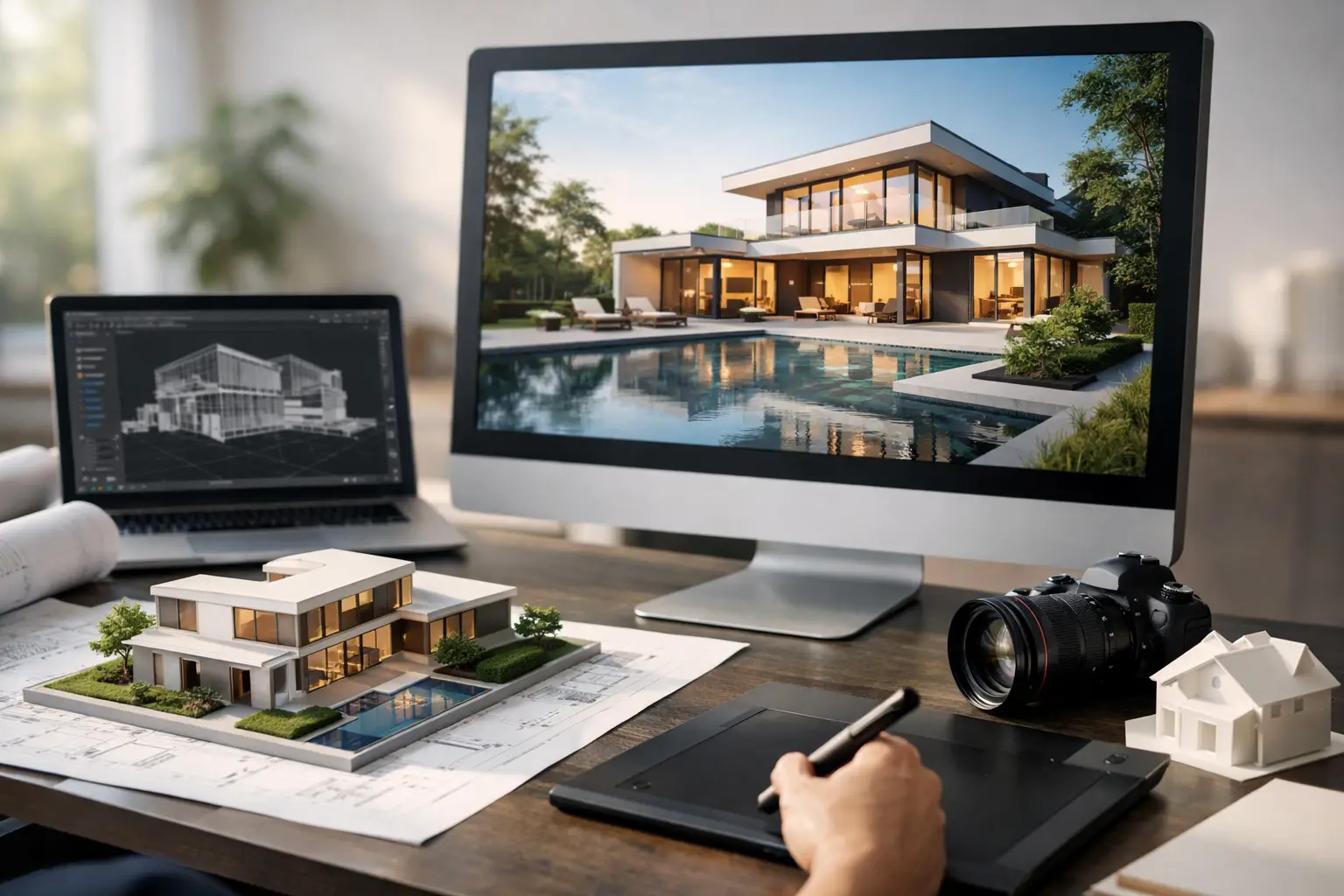
Architectural CGI is the creation of computer-generated imagery that represents an unbuilt, refurbished or hard-to-photograph space. It may include exterior views, interior scenes, aerial perspectives, animations, interactive tours and virtual staging. The technical process matters, but the commercial purpose should lead every decision.
For a residential development, the priority may be making a buyer understand the relationship between a kitchen, living space and garden. For a commercial scheme, it may be showing access, footfall potential, branding opportunities or the quality of a reception area. An architect may need a planning image that accurately communicates massing and materiality, while a marketing team may need a warmer campaign visual that helps people picture themselves there.
These are related requirements, but they are not identical. The strongest projects set the intended audience and use case before the first camera angle is chosen.
Start with the brief, not the render
A clear brief protects both quality and budget. It avoids a common issue in CGI production: creating a technically impressive image that does not answer the question the audience is asking.
At the outset, establish what the visuals must help achieve. This could be early interest before a sales launch, planning communication, investor confidence, pre-let marketing or a coordinated campaign for a multi-phase scheme. Decide where the assets will appear too. A wide hero image for a brochure cover requires a different composition from a vertical social advert, a website banner or a large-format sales-suite panel.
The brief should confirm the number of images, viewpoints, required formats, target dates and approval process. It should also identify who has final sign-off. When several consultants are involved, a defined review route prevents contradictory feedback and late changes.
Provide accurate source material
CGI quality is closely tied to the information supplied. Architectural drawings, elevations, sections, site plans, material schedules, landscape proposals and interior specifications all help build an accurate scene. Even early-stage information can be sufficient, provided assumptions are identified and managed.
Reference images are particularly valuable for communicating intent. They can show the desired lighting, mood, furniture style, planting maturity, local character or level of visual polish. They should guide the creative direction rather than replace project-specific information. A reference might capture the feel of a quiet, design-led flat, but the proposed development still needs its own architecture, proportions and identity.
Choose views with a purpose
The most useful architectural CGI is selective. A large set of similar angles rarely adds value, particularly when marketing budgets are under scrutiny. Instead, select views that explain the features most likely to influence a decision.
An exterior hero view can establish the development’s presence, architecture and setting. A street-level approach may show arrival and public realm. An elevated view can clarify the site within its surroundings. Internally, one image might focus on the open-plan living area while another communicates a principal bedroom, a distinctive bathroom or a shared amenity space.
Camera placement should feel natural but intentional. Overly wide lenses can distort rooms and make spaces appear implausibly large. Views that are too distant can lose the detail that supports a premium position. The right balance depends on the property and audience, but credibility should always outweigh visual exaggeration.
For larger schemes, create a view schedule before production begins. This gives every image a job and ensures the final set works together across print and digital applications.
Detail is where credibility is won
Photorealism is not simply a matter of sharp textures and dramatic lighting. People quickly notice when a façade material repeats unnaturally, furniture is incorrectly scaled or landscaping does not match the season implied by the campaign. They may not articulate the problem, but the image feels less trustworthy.
Good CGI combines architectural accuracy with considered styling. Brick, timber, stone, metalwork and glazing should respond to light in a convincing way. Interiors need a coherent furniture scheme, appropriate accessories and enough lived-in detail to feel welcoming without becoming cluttered. Exterior scenes benefit from believable planting, restrained activity and contextual cues that give a place a sense of life.
There is a commercial trade-off here. Every bespoke model, specialist finish and detailed surrounding building increases production time. Not every image needs the same level of detail, particularly where an asset will be viewed at a small size. The practical approach is to invest detail where the viewer will notice it: focal façades, key rooms, branded amenities and close-up campaign images.
Lighting and lifestyle should support the proposition
Lighting sets more than mood. It directs the eye, reveals materials and shapes the perceived quality of a space. A bright daytime exterior may be right for a family housing development where landscape and neighbourhood context are central. A dusk image can give a city-centre scheme a more aspirational, hospitality-led character, especially when warm interior light makes the building feel active and occupied.
Neither option is automatically better. Dusk imagery can be highly effective, but it may obscure important architectural detail or site context. Daylight can be clearer and more informative, yet feel less distinctive if handled without care. The decision should reflect the development’s position, the campaign message and the channels where the image will be used.
The same applies to people within a scene. Figures can add scale and show how a place is used, but they should not distract from the architecture. A considered image suggests a lifestyle without looking like a stock photograph placed over a building.
Build CGI into the wider campaign
A visual campaign is more persuasive when CGI, branding and printed materials speak the same language. Type, colour, iconography, floor plans, site plans and image treatment should reinforce one another. If these elements are created by separate suppliers without a shared direction, the result can feel fragmented even when each individual item is strong.
This is where a combined CGI and graphic design studio offers a practical advantage. TDR Creative can develop imagery alongside brochures, site plans, floor plans and campaign materials, helping ensure that the development is presented with consistent visual standards from initial teaser through to sales collateral.
Think beyond the initial set of stills. A carefully built model can support additional outputs such as virtual staging, interactive 360-degree tours, animation sequences and alternate seasonal or evening views. Planning these possibilities early can make later campaign activity more cost-effective than starting from scratch.
Manage feedback without diluting the work
CGI projects benefit from structured stages. Initial camera compositions should be approved before detailed rendering begins. This is the right point to amend viewpoint, crop, focal features and the overall story of the image. Once the scene moves into detailed material, lighting and styling work, changes can have wider implications.
Feedback is most useful when it is specific and consolidated. Rather than saying an image needs to feel more premium, identify what is driving that response. Is the furniture too generic? Does the lighting need greater contrast? Is the landscape too sparse? Does the façade need a more accurate material finish? Clear comments enable purposeful revisions and protect the production schedule.
Accuracy must remain central. Marketing CGI can be aspirational, but it should not promise features that will not be delivered. Where designs are subject to change, use approved wording and appropriate visual disclaimers within the final campaign materials. Trust is difficult to win and easy to lose when an image overstates the finished product.
Assess value by usefulness, not image count
The cheapest quote is not always the most economical route, and the highest number of images is not necessarily the best investment. Value comes from producing the right assets to a dependable standard, in formats that work across the campaign, with a process that respects launch dates and approval requirements.
When comparing suppliers, ask how they approach architectural accuracy, project management, revision rounds, source-file requirements and cross-channel delivery. Review work similar to your project in scale and market position. A polished single dwelling does not automatically demonstrate experience of a large masterplan, just as a strong exterior portfolio may not prove the ability to style high-end interiors.
A strong CGI partner will be candid about what is possible within the brief, where additional detail will make a genuine difference and where it will not. That balance of creativity, precision and commercial judgement is what turns visualisation into useful marketing.
The most effective architectural imagery gives people a reason to pause, understand the proposition and take the next step. Begin with the decision your audience needs to make, then build every view around helping them make it with confidence.
