Home » CGI Interiors Versus Show Homes – Which Works?
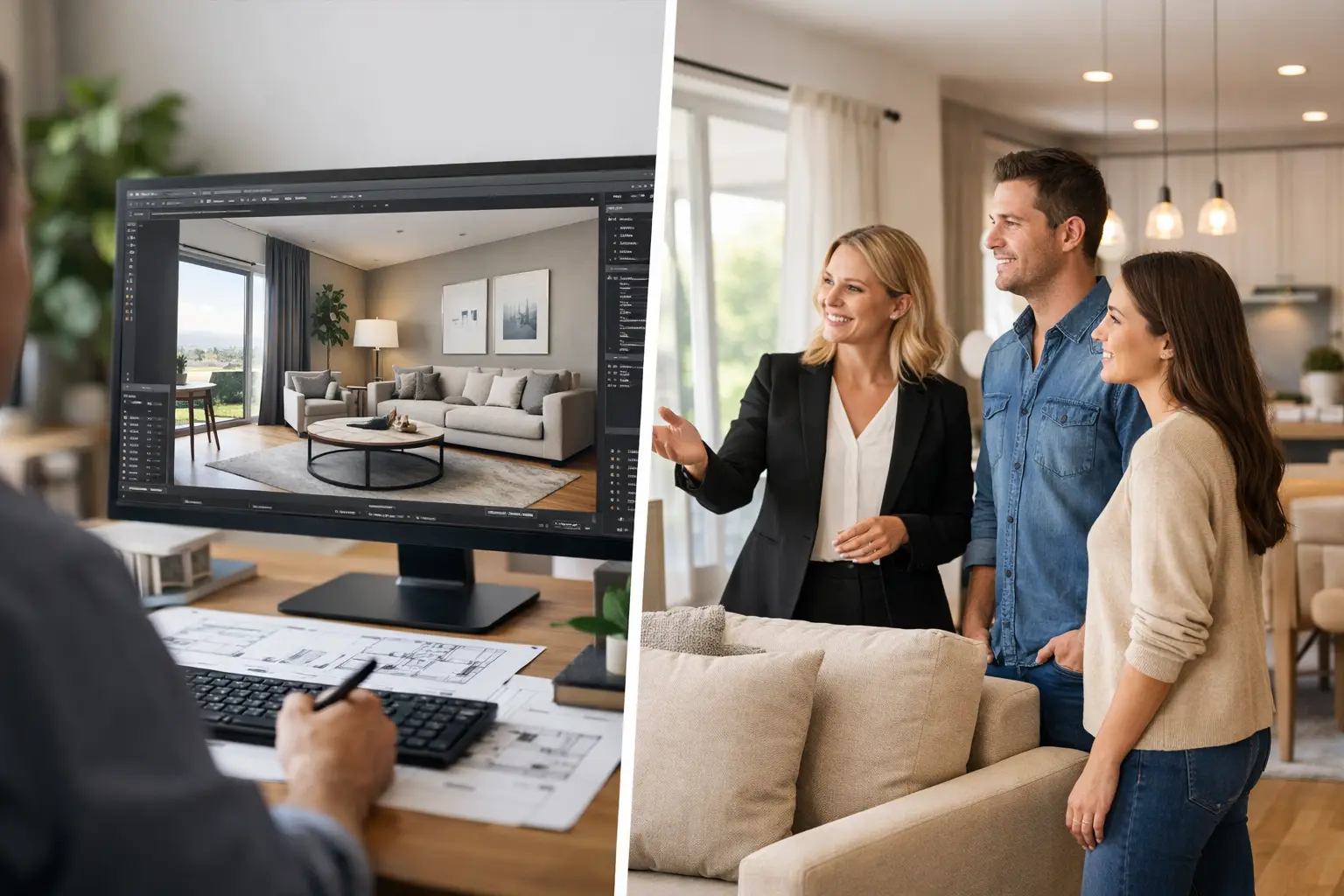
CGI Interiors Versus Show Homes – Which Works?
A buyer may first encounter a new home while it is still a concrete frame, a fenced-off plot or a site plan on a sales-suite wall. That makes the choice between CGI interiors versus show homes more than a presentation decision. It affects launch timing, marketing spend, buyer confidence and how clearly people can picture themselves living in the development.
For house builders, developers and their marketing teams, neither option is automatically the right answer. A show home creates a physical experience that can be highly persuasive at the point of sale. Interior CGI creates a controlled, flexible and scalable sales asset long before a plot is ready for viewings. The strongest approach depends on the development, the buyer, the sales strategy and the stage of construction.
What a show home does best
A professionally dressed show home gives prospective buyers something tangible. They can walk through the rooms, understand the relationship between spaces, assess natural light and get a feel for the quality of finishes. For buyers making a significant commitment, that physical reassurance matters.
It can also establish the desired tone for a development. Thoughtful furniture, styling and accessories give a room warmth and aspiration, helping buyers associate an otherwise empty property with a particular lifestyle. On higher-value schemes, or developments where fit and finish are a major part of the proposition, this can support the premium being asked.
A show home is particularly effective when the site has regular footfall and the sales team can use it as a practical conversation tool. A buyer can stand in a kitchen, discuss upgrade options and move straight into questions about availability, completion dates or incentives.
There are limitations, however. A physical show home represents one layout, one plot type and one carefully selected interior scheme. It cannot easily show alternative kitchens, flooring packages, colour palettes or the view from every flat. Once installed, changing the presentation takes time, coordination and further budget.
Where interior CGI earns its place
Interior CGI turns plans, specifications and design intent into a photorealistic view of a finished home. It allows a scheme to be marketed before construction is complete, allowing the sales campaign to begin earlier and work harder for longer.
The commercial advantage is not simply that CGI looks polished. It is that the same approved visual can be adapted across brochure spreads, sales-suite displays, property portals, social content, email campaigns and presentations. A coordinated set of images can show each key room, multiple house types and the details that distinguish the scheme without repeatedly building and dressing physical spaces.
CGI also provides much greater control. The camera angle can be selected to explain an awkward layout. Lighting can reflect the intended character of the room. Furniture can be scaled accurately, and materials can be matched to a confirmed specification. Where buyers are choosing between packages, separate visual sets can demonstrate the difference clearly rather than leaving the decision to imagination.
This flexibility is valuable on flat developments, where many homes share a base layout but differ in orientation, outlook or finish. It is equally useful for a development with several buyer profiles. A city-centre flat may benefit from a confident, contemporary look, while a family house can be styled around practical everyday living. The architecture remains consistent, but the visual story becomes more relevant to its audience.
CGI interiors versus show homes: the cost and timing question
A show home has costs beyond furniture and styling. There may be fit-out works, rental or purchase costs, installation, maintenance, cleaning, utilities, insurance and the opportunity cost of taking a completed unit out of stock. If the property is sold later than comparable plots, that should be factored into the overall calculation.
CGI involves an upfront creative investment, but it is generally easier to scale. Once the architectural information, materials and core design direction are agreed, additional views, alternative finishes and selected variations can be produced without the physical logistics of refitting a home. It also avoids waiting until a suitable plot is complete.
That does not mean CGI is always less expensive in every situation. A single simple image may be cost-effective, but a substantial campaign with numerous house types, bespoke styling, animation and interactive content requires a properly planned budget. The key comparison is not the cost of one image against one room. It is the cost of creating enough high-quality material to sell the development effectively across its full marketing cycle.
Timing is often the deciding factor. If off-plan sales are needed to support funding, build momentum or meet a launch deadline, interior CGI gives the sales team credible material while the site is still progressing. A show home may follow later, reinforcing the campaign when buyers are able to experience the product in person.
The buyer experience is different, not lesser
There is a temptation to treat CGI as a substitute for a real room. It is better understood as a different sales tool with different strengths.
A show home answers the emotional question: what will it feel like to be here? CGI answers the visual and practical questions: what will this home look like when finished, how might this layout work, and what can I expect from this specific plot or specification?
High-quality CGI can be especially persuasive for buyers who begin their search online. Before they book an appointment, they want to understand the offer quickly. Empty-room photography rarely achieves this, particularly during construction. A considered CGI interior gives them a reason to enquire, while floor plans, site plans and clear specifications supply the supporting detail.
Accuracy is essential. Photorealism should never come at the expense of honest representation. Room proportions, ceiling heights, window positions, finishes and included items must be checked against the latest approved information. Where furniture, accessories or upgrades are illustrative, the marketing material should make that distinction clear. Credibility is harder to win than attention, and far more valuable.
When a hybrid approach delivers more value
For many developments, the most strategically effective answer is not choosing one over the other. It is using CGI early to build interest and using a show home later to convert buyers who want physical reassurance.
The campaign can begin with interior and exterior CGI, supported by accurate floor plans, site plans and branded sales collateral. As the build programme advances, 360-degree interactive tours or animation can add depth for remote buyers and investors. Once a show home is available, it becomes an additional proof point rather than the sole source of visual material.
This approach also prevents the show home from carrying too much responsibility. It may be perfectly styled for one house type, but CGI can continue to explain the full range of plots, flats and options. The result is a more consistent buyer journey, from first online impression to sales-suite visit and reservation.
Choosing the right route for your scheme
The practical decision comes down to a few connected questions. How early must the development be marketed? How many property types and finish options need to be communicated? Is the target audience likely to visit the site before reserving? Does the scheme rely on a premium, tactile experience, or does it need broad online reach at pace?
A smaller, near-complete development with a focused local buyer pool may gain most from an exceptional show home and a concise set of supporting visuals. A large phased scheme, block of flats or off-plan launch will usually benefit from a wider CGI programme, because it needs to sell variety before every plot can be seen.
The quality of execution matters whichever route is selected. A poorly dressed show home can make a good property feel generic. Equally, CGI that is inaccurate, over-styled or detached from the brand can create doubt rather than desire. The work needs to blend creativity with precision, with design decisions serving the sales objective rather than distracting from it.
At TDR Creative, this is where an integrated studio approach can make a material difference. Interior CGI, floor plans, brochures and campaign graphics can be developed around the same visual direction, helping buyers receive a consistent message at every stage.
The most useful question is not whether CGI or a show home is better. It is which combination will give buyers enough confidence to act, while giving the development the strongest possible start in market.
