Home » CGI vs Photography for Commercial Projects
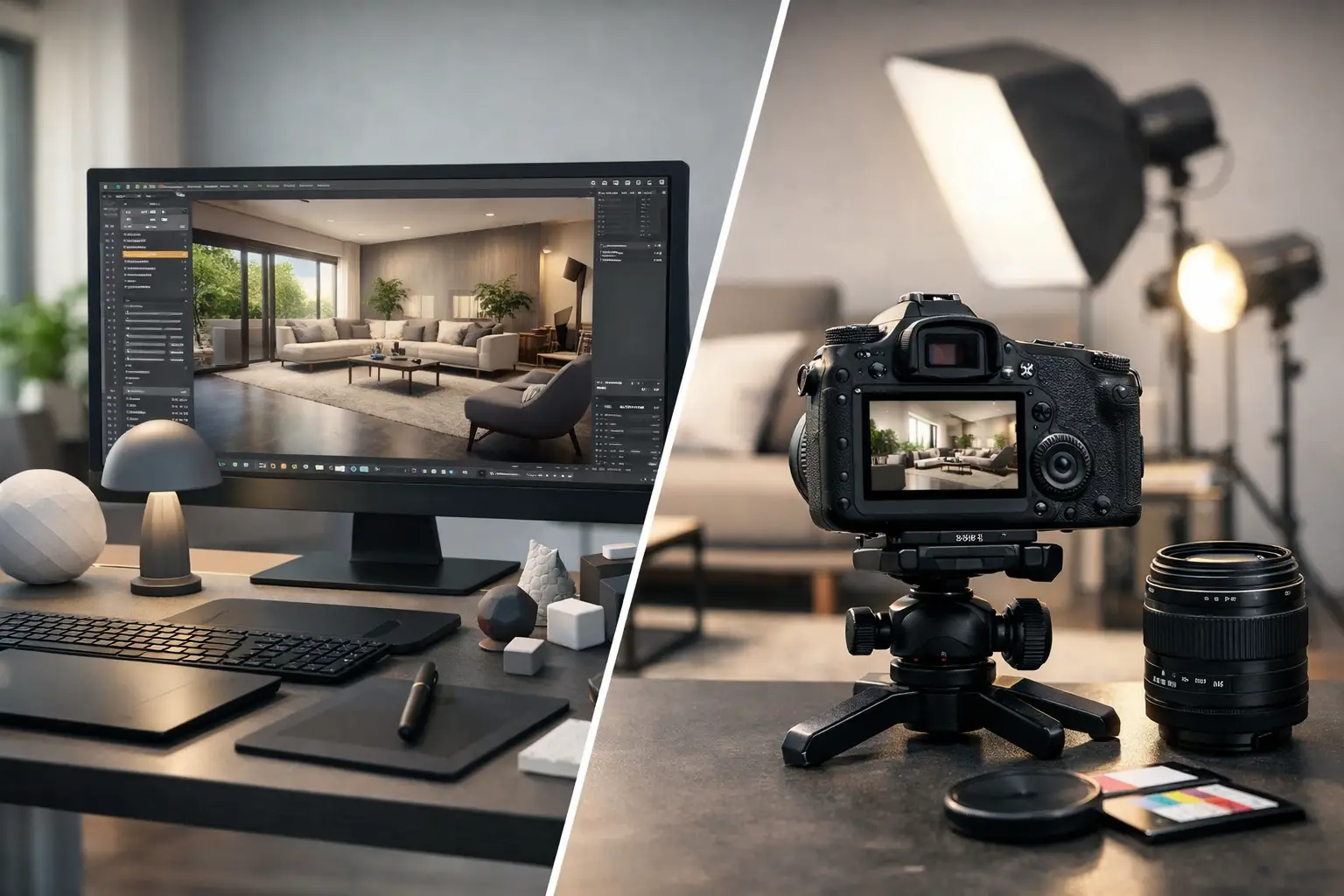
CGI vs Photography for Commercial Projects
A development launch date does not wait for the landscaping to mature, the interiors to be fitted or the weather to cooperate. That is where the CGI vs photography decision becomes commercially significant. Both can produce compelling marketing assets, but they solve different problems. Choosing well affects not only the look of a campaign, but also its timing, budget, flexibility and ability to sell a vision before it physically exists.
For property developers, architects, house builders, estate agents and brand teams, the strongest answer is rarely that one format is always better. It is about matching the visual method to the stage of the project, the audience’s expectations and the decisions the image needs to support.
CGI vs photography: the fundamental difference
Photography records a real subject at a real moment. Its strength lies in authenticity: the texture of materials, natural light, lived-in details and the confidence that comes from showing something as it is. For a completed development, an installed retail space or an established product range, professional photography can communicate quality with immediate credibility.
CGI, by contrast, creates the image before the subject, setting or final conditions need to exist. A visual can be built from architectural drawings, CAD files, material references, product specifications and a clear creative brief. This gives a marketing team the freedom to show an exterior at golden hour, a flat dressed for a defined buyer profile, or a product in a campaign setting that would be difficult or costly to arrange physically.
The distinction is not simply real versus artificial. High-quality CGI is a controlled visual production process. It combines accurate modelling, considered composition, lighting, material work and retouching to create an image that feels believable while serving a specific commercial purpose.
When CGI gives a project the advantage
CGI is particularly valuable when a project is still on the drawing board, under construction or awaiting final finishes. A single photorealistic exterior visual can help secure early interest in a scheme, support planning communications, strengthen a sales brochure and give agents material to use well before practical completion.
That lead time matters. Waiting for photography can mean waiting for construction, access, furnishing, landscaping and suitable conditions. By then, a campaign may have lost valuable months. CGI allows sales and marketing activity to begin from approved plans, helping teams build momentum earlier and present a consistent vision throughout the project lifecycle.
Control is the other major benefit. Every element can be considered against the campaign objective. The camera angle can prioritise kerb appeal. The time of day can complement the architectural style. Furniture can reflect the intended market, while branding, signage and surrounding context can be managed with care. This is useful for developments where the final setting may be changing quickly, or where several plots need a coherent visual language.
For consumer brands, product CGI can offer similar gains. Multiple colourways, finishes, pack formats or configurations can be created without producing and photographing every physical variation. The same core asset can then be adapted for packaging, point of sale, digital campaigns and brochures, keeping the presentation aligned across channels.
CGI also makes revisions more manageable than a reshoot when the underlying design changes. A revised cladding tone, kitchen finish, product label or landscape treatment can be updated within the visual production process. That does not mean revisions are without cost or time, particularly where changes affect the model or composition substantially. However, the ability to amend a digital scene can protect a campaign from avoidable disruption.
Where photography remains the right choice
Photography has qualities that CGI should not be expected to replace. If the aim is to show a completed space, demonstrate workmanship, document an event or capture the character of a real location, photography is often the most direct and persuasive option.
A finished show home benefits from photography because buyers want evidence of the actual standard of fit-out, light levels and views. A hospitality venue may need the energy of genuine guests and staff. A brand with a tactile, handmade product may want to foreground the small imperfections that prove its material reality. In these cases, a well-planned shoot can create trust in a way that feels immediate and unforced.
Photography can also be cost-effective for straightforward projects. If the subject is ready, accessible, styled and available in the right conditions, a shoot may be quicker than commissioning a detailed 3D model from scratch. It is not automatically cheaper, though. Location preparation, propping, styling, travel, permissions, retouching and weather contingency all need to be considered when comparing quotes.
The limitation is that photography captures what is available on the day. If a key room is unfinished, the exterior is obscured by site activity or the required product version has not arrived, the image may not meet the campaign brief. Retouching can improve an image, but it cannot always solve fundamental gaps in the scene.
Compare the decision factors, not just the headline cost
A CGI commission and a photography shoot should be assessed as full production choices rather than line items. The lower initial estimate is not always the better value if it delays a launch, limits usage or leads to repeated work later.
Four practical questions usually clarify the right route:
- Is the subject complete and ready to present at the required standard?
- Does the campaign need to begin before construction, installation or product manufacture is finished?
- Will the visual need variants, future updates or use across several formats?
- Is the main objective to document reality, or to communicate a planned experience?
If the project needs images before it exists, CGI is the clear starting point. If it needs proof of a completed result, photography is likely to carry more weight. Where the campaign requires both aspiration and evidence, a combined approach is often the most effective.
For example, a residential development might use CGI exteriors, interior visuals, floor plans and virtual staging during off-plan sales. Once show homes and communal areas are complete, professional photography can take over for listings, social content, press activity and customer-facing materials. The visual identity should remain consistent, even though the production method changes.
Realism depends on information and craft
The concern many clients raise about CGI is whether it will look real. That is a sensible question, especially where the visual will influence a buyer, investor or stakeholder. Photorealism is not achieved by software alone. It depends on the quality of the source information, attention to architectural detail, accurate materials, believable lighting and careful post-production.
The brief is central. Drawings should be current, dimensions clear and material references specific. If the design intent includes a particular brick, metal finish, kitchen range or planting style, that information needs to be shared early. The more precise the inputs, the more confidently the visual can represent the intended scheme.
Equally, realism should not become an excuse for overpromising. CGI used for marketing must remain faithful to the approved design and should not imply inclusions, views or specifications that cannot be delivered. A strong creative partner will ask the right questions, identify ambiguity and make sure the visual is both persuasive and responsible.
Photography requires craft too. Lens choice, lighting, styling and retouching all influence how a finished space or product is perceived. An average photograph can undersell an excellent project just as readily as an inaccurate CGI can undermine trust. The standard of production matters in both disciplines.
Build a joined-up campaign, not a collection of assets
The most effective property and brand marketing does not treat images as isolated deliverables. A CGI exterior should work with the brochure cover. Interior visuals should reflect the messaging, palette and buyer profile. Site plans, floor plans, animation and presentation materials should feel as though they belong to one campaign.
This is where an integrated creative studio model has practical value. When CGI visualisation and graphic design are developed together, choices about composition, colour, typography and hierarchy can be made with the wider marketing system in mind. There is less risk of a striking visual being dropped into collateral that tells a different story.
At TDR Creative, this joined-up approach helps clients move from early concepts to polished campaign materials with one collaborative team overseeing the visual direction. It is particularly useful when deadlines are tight and several outputs need approval at the same time.
Start with the decision your audience needs to make
The right choice between CGI and photography begins with a simple question: what must this visual help someone understand, believe or do? A buyer may need to picture a future home. An investor may need confidence in the scale and finish of a proposal. A customer may need to see the real product in use.
Choose CGI when control, early marketing and visualising the unbuilt are the priority. Choose photography when the completed reality is the message. And where the project deserves both, plan them as complementary stages of one considered campaign – so every image moves the audience closer to a decision.
