Home » What Is Virtual Staging? A Practical Guide
What Is Virtual Staging? A Practical Guide
An empty room can be technically impressive yet commercially difficult to sell. Bare walls, unfamiliar proportions and an absence of scale leave buyers, tenants and investors to do too much of the imagining themselves. Virtual staging gives them a more immediate, credible view of how a space could live, work or perform.
What is virtual staging in property marketing?
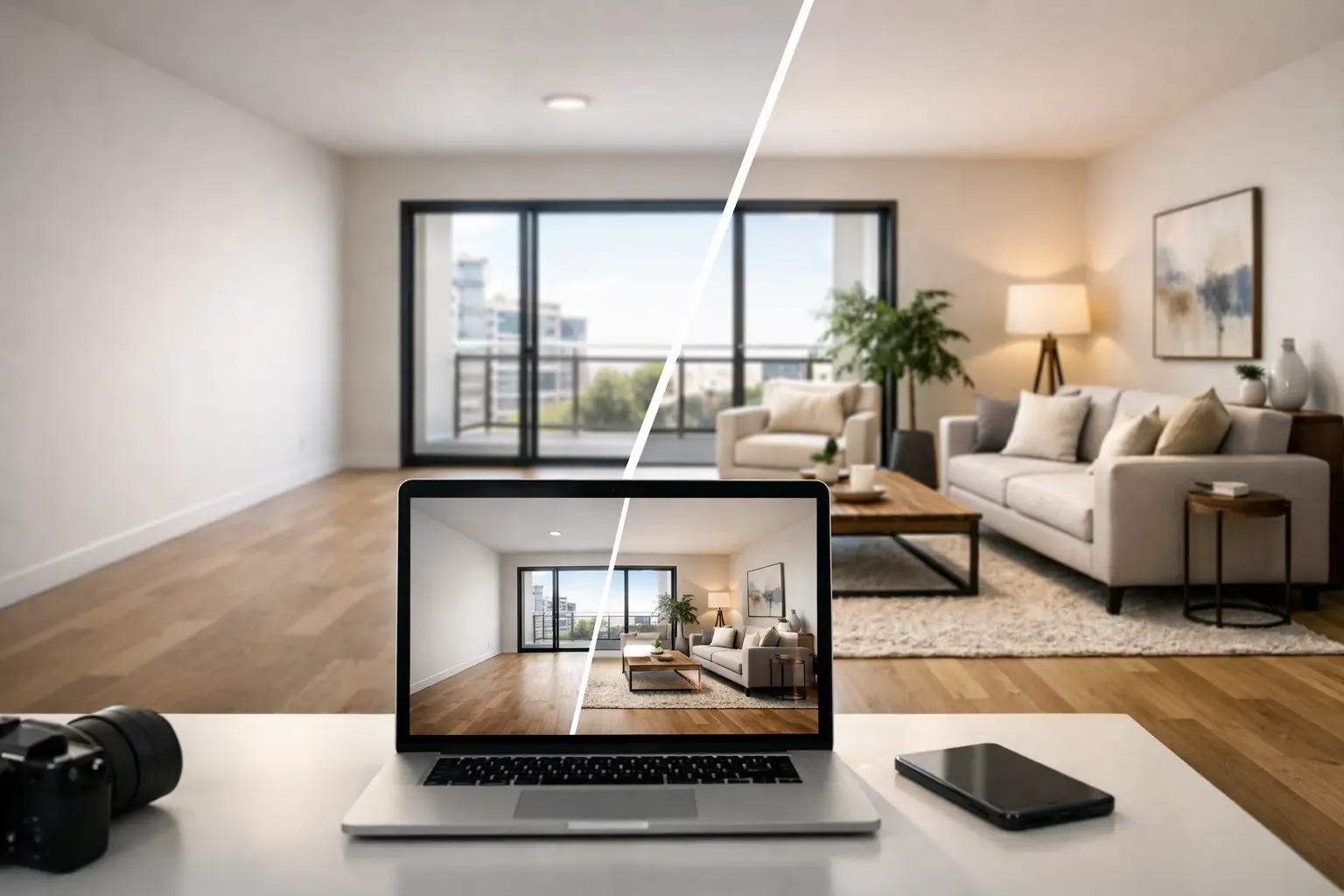
What is virtual staging? It is the process of adding realistic digital furniture, lighting, artwork, soft furnishings and accessories to photographs or CGI images of an empty property. The finished image presents the room as furnished without the cost, time and logistics of physically hiring, delivering and styling furniture on site.
The aim is not simply to make a room look attractive. Effective virtual staging helps an audience understand scale, layout and intended use. A compact second bedroom can be shown as a practical home office; an open-plan living area can demonstrate how dining, relaxing and entertaining zones may work together; a newly built flat can feel less like a shell and more like a home.
For developers and estate agents, it is a particularly useful marketing tool when a property is vacant, still under construction or spread across several similar units. It can also support architectural and interior design teams that need to communicate a design direction before physical fit-out begins.
Why empty spaces often underperform
Most buyers do not assess property like a floor-plan technician. They respond to atmosphere, proportion and the feeling that a space suits their life. An unfurnished room may appear smaller than it is, while a large open area can feel impersonal or difficult to plan.
Furniture provides visual reference points. A sofa shows the width of a living room. A dining table clarifies circulation space. A bed and bedside tables make the purpose of a room immediately recognisable. Virtual staging makes those cues available in the first image a prospect sees, whether that is on a property portal, in a brochure, across social media or within a sales presentation.
This matters most where marketing has to begin before a development is complete. Rather than waiting for a show home or investing in physical staging across multiple plots, teams can prepare polished campaign imagery that supports early interest, off-plan sales and investor conversations.
How virtual staging is created
The process usually begins with high-quality photography of the vacant property or a base CGI visual for an unbuilt space. Camera angle, lens choice, lighting and image resolution all influence the final result. A weak source image limits how convincing the staged result can be.
A CGI artist then studies the architecture, room proportions, finishes and likely audience. Furniture is selected to suit the development’s positioning, rather than added as generic decoration. A city-centre rental flat may require a clean, contemporary scheme; a family house may benefit from warmer materials and practical, lived-in details; a premium development may call for a more refined interior palette.
The furniture and accessories are placed in three dimensions so that their perspective matches the photograph or visual. Shadows, reflections, light direction and contact with the floor must also be considered. These details are where staging either feels believable or immediately artificial. A chair that floats slightly above a rug, or a lamp with no relationship to the room’s light, weakens confidence in the entire image.
The best results are reviewed as part of the wider marketing system. The visual style should sit comfortably alongside exterior CGI, floor plans, brochures, site plans and brand materials. At TDR Creative, this joined-up approach helps ensure that a development is presented with consistency across every client-facing asset, not as a collection of disconnected visuals.
Virtual staging, physical staging and interior CGI
Virtual staging is often confused with physical staging and full interior CGI, but each serves a different purpose.
Physical staging involves placing real furniture and accessories in a completed property. It can be highly effective for viewings because visitors experience the space in person. However, it carries costs for hire, delivery, installation, insurance and removal, and it is not always practical across several units or locations.
Virtual staging works from an existing photograph or visual. It is generally more flexible and cost-effective where the requirement is for marketing imagery rather than an in-person viewing experience. Furniture can be changed without revisiting the property, which is valuable when testing different buyer profiles or creating variations for different flat types.
Interior CGI is normally created from architectural drawings, specifications and design information rather than a completed photograph. It is the appropriate option for a property that does not yet exist, or where the required camera view cannot be photographed. In many campaigns, interior CGI and virtual staging work side by side: CGI sells the future development, while virtual staging enhances completed but vacant units.
Where virtual staging adds the most value
Virtual staging is especially effective for vacant new-build homes, rental flats, refurbishment projects and show-home alternatives. It can make a limited number of completed units work harder by showing distinct layouts or interior schemes without fitting out every plot.
It is also useful for commercial property. An empty office can be staged with workstations, meeting areas and breakout spaces to demonstrate capacity and workplace potential. A retail unit can suggest how a branded environment may occupy the space. In these cases, accuracy matters: the visual should support a realistic understanding of use, not create a misleading impression of what the building can accommodate.
For marketing teams, staged images can be adapted for a range of formats, from property listings and brochures to hoardings, email campaigns and presentation decks. Planning image crops early prevents important furniture, features or selling points from being lost when the asset is reformatted.
The trade-offs to manage carefully
Virtual staging is powerful, but it is not a substitute for honest property marketing. The staged image should reflect the actual room dimensions, architectural features and condition. It should not conceal defects, remove permanent elements or imply a level of finish that is not included in the sale or tenancy.
Clarity is essential. Where appropriate, marketing material should make clear that furniture and accessories have been digitally added, particularly if an audience might reasonably assume that they are part of the property. Providing unstaged photographs alongside staged versions can also help prospects assess the space with confidence. Requirements can vary by channel and campaign, so estate agents and developers should apply their usual advertising and consumer protection checks.
There is also a question of style. Overfilling a small room with furniture may make it look luxurious in isolation but undermine the sense of space. Equally, a sparse layout can leave the room feeling cold. The right scheme is proportionate, commercially relevant and aligned with the likely buyer or tenant.
Photorealism should be the standard, not an optional extra. Poorly matched perspectives, unrealistic styling or low-resolution assets can make a development feel less considered. Choosing experienced CGI specialists is therefore as much a brand decision as a production decision.
Briefing a virtual staging project well
A productive brief gives the creative team enough information to make sound decisions without slowing the project down. Start with the intended use of the images: are they for off-plan sales, a portal listing, a brochure, investor marketing or a planning presentation? The answer shapes the level of detail, output sizes and style.
It also helps to share room dimensions, floor plans, finish schedules, photography and any existing brand or campaign materials. If a target audience has already been identified, describe it. A first-time buyer, downsizer, family purchaser and corporate tenant may all respond to a different interior approach.
Finally, agree the revision process and required delivery date from the outset. Virtual staging is efficient, but considered review remains important. Checking furniture scale, room use, finishes and image crops before final approval protects both the quality of the asset and the pace of the wider campaign.
The strongest virtual staging does not ask people to admire the image for its own sake. It helps them picture themselves in the property, understand its potential and take the next step with greater confidence.
