Home » How Virtual Staging Attracts Buyers to Property
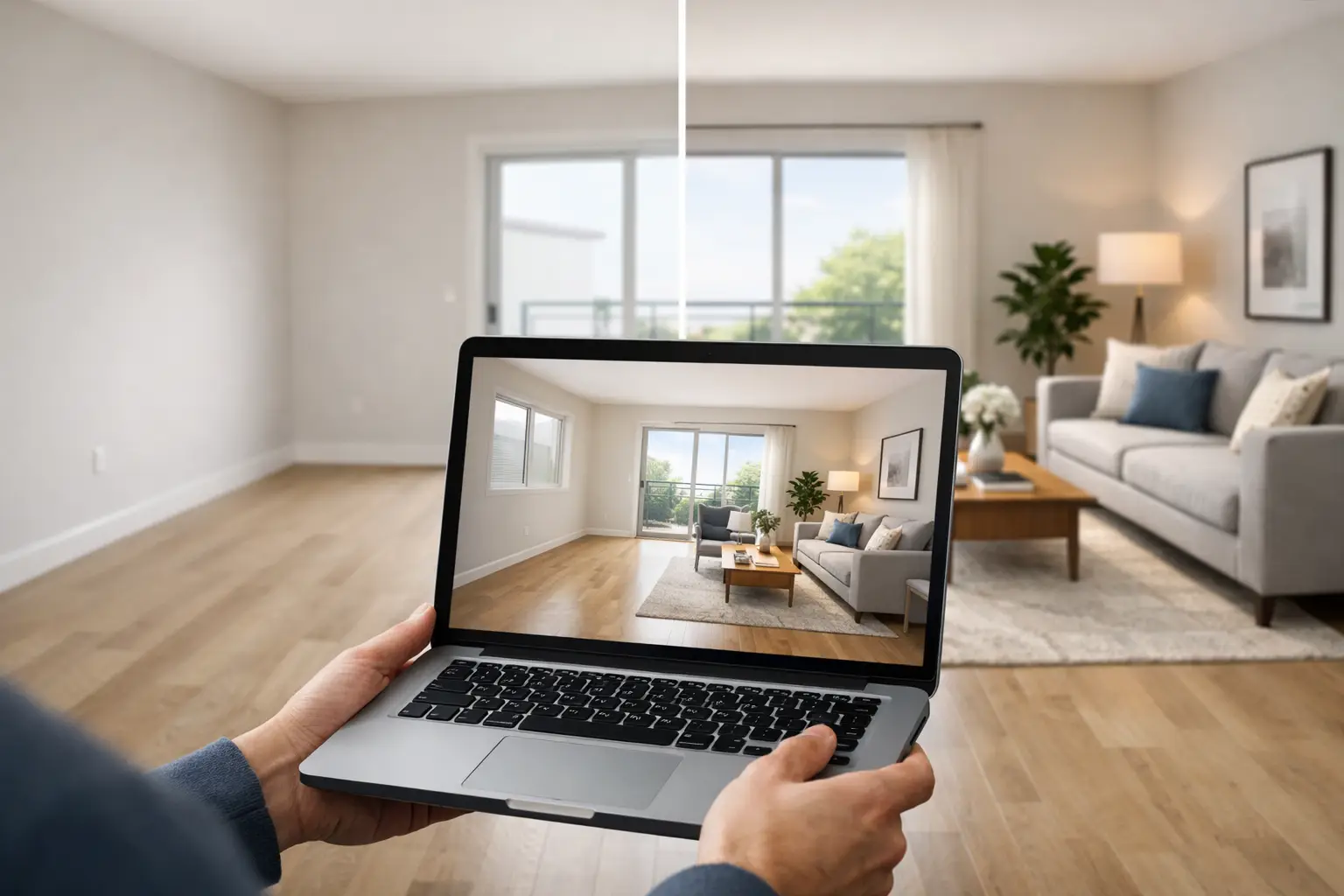
How Virtual Staging Attracts Buyers to Property
A vacant living room can look smaller than it is. An empty bedroom can leave buyers unsure whether a double bed will fit. That hesitation matters when a listing has only seconds to earn attention. Understanding how virtual staging attracts buyers begins with this simple commercial reality: people respond more confidently when they can see how a space could work for them.
For developers, estate agents and marketing teams, virtual staging turns an unfurnished interior image into a considered lifestyle visual. Furniture, lighting, artwork and accessories are added digitally to show scale, function and character without the cost, coordination and physical constraints of dressing every property. Done well, it makes the marketing clearer, not merely prettier.
How virtual staging attracts buyers at first glance
Most buyers begin their search on a screen, comparing dozens of properties in a single session. Images need to communicate quickly, particularly for new-build homes, rental schemes, show flats and properties that are vacant between tenancies. A professionally staged CGI image gives the eye a focal point and helps a room feel immediately legible.
A sofa establishes the proportions of a lounge. A dining table demonstrates that a kitchen-diner can support everyday life as well as entertaining. A carefully selected bed, desk or reading chair gives a spare room a purpose. These details reduce the work a buyer has to do in their imagination, which can make a listing more memorable and encourage a closer look.
The effect is not about disguising a weak property. It is about presenting its genuine potential with enough visual context for buyers to understand it. Empty rooms can feel cold or ambiguous in photography, even where the layout and finish are strong. Virtual staging allows those strengths to be seen in a more useful way.
It turns floor area into a believable lifestyle
Buyers do not only assess square footage. They ask practical, often unspoken questions: Where would the family eat? Could I work from home here? Is there room for storage? Would this be comfortable at the end of a long day? Virtual staging helps answer those questions before a viewing is booked.
Scale becomes easier to judge
Room dimensions on a floor plan are essential, but they are not always intuitive. Appropriate furniture placement offers a visual reference point. A full-size sofa, bedside tables and a rug can show that a room has generous circulation space. Equally, a more compact furniture scheme can show how a smaller city-centre flat could be arranged intelligently.
Accuracy is crucial. Furniture should be proportionate to the room and positioned in a way that respects doors, windows, radiators and walkways. If a staged image suggests a layout that could not work in reality, it damages trust at the viewing stage. High-quality virtual staging blends creativity with precision, keeping the image aspirational while staying faithful to the property.
Buyers can see a room’s purpose
One of the most valuable applications is the flexible room. A box room may be a home office, nursery, dressing room or guest bedroom, depending on the buyer. A staged visual can demonstrate one compelling option, while a second image may show an alternative use where that would strengthen the marketing.
This is especially useful in developments with several similar units. A consistent visual approach can distinguish flat types and help prospective purchasers identify the layout that suits their needs. It also supports off-plan sales, where the buyer needs to make decisions before there is a finished space to walk through.
The emotional connection arrives earlier
Property decisions involve logic, but emotion has a major role. A well-composed interior with natural-looking light, restrained styling and believable details helps a buyer picture their own routine within the space. That feeling can prompt an enquiry, a brochure request or a viewing.
The strongest images leave room for the buyer’s imagination. They do not overwhelm a property with statement furniture or decorate it so specifically that only one taste is represented. Neutral, contemporary styling generally broadens appeal, while still giving the interior warmth and a sense of aspiration.
Better visuals support better-qualified enquiries
Virtual staging can increase interest, but its value is not limited to chasing the largest possible number of clicks. For a sales team, it can also help attract people who have a more accurate understanding of the property before they arrive.
When buyers can see the likely scale and use of each room, conversations start at a more productive point. The agent or sales adviser can focus on specification, location, incentives and the buyer’s priorities rather than explaining what an empty room might accommodate. This is particularly helpful for busy developments and campaigns with a limited sales window.
Staged imagery also provides flexible material for brochures, property portals, social campaigns, sales suites and email communications. Using a coordinated set of visuals across these touchpoints builds familiarity. The property looks considered wherever it appears, rather than relying on disconnected assets produced at different stages of the campaign.
For house builders and developers, that consistency matters beyond an individual plot. It helps establish the character of a scheme, whether the intended market is first-time buyers, families, downsizers or the premium rental sector. The style should reflect the audience and the architecture, not a generic interior trend.
Where virtual staging delivers the strongest return
The case is strongest where physical dressing is impractical, expensive or premature. A vacant resale property may need to go live quickly. A development may have several unit types but only one furnished show home. A build may still be in progress, making photography impossible. In each situation, virtual staging creates a market-ready image without moving furniture, arranging access or committing to short-term hire costs.
It is also useful for testing presentation. A marketing team might compare a family-oriented arrangement with a more design-led city living scheme, depending on the likely audience. This does not mean producing images without a strategy. The visual direction should be agreed at the outset, informed by the property, location, price point and campaign objective.
That said, physical staging still has a place. For an open-house event, show home or premium property where visitors need a fully immersive experience, real furniture can be highly effective. Virtual staging is not a replacement for every setting. It is a cost-effective option when speed, flexibility and broad marketing coverage are the priority.
What makes a virtual staging image credible
Buyers are increasingly visually literate. Poorly matched shadows, floating furniture, distorted proportions and overly glossy finishes are quickly noticed. An image that looks artificial can create scepticism rather than interest, so technical quality is inseparable from marketing performance.
A credible result begins with a strong base photograph or interior CGI. Perspective, lens angle, daylight and existing finishes need to be understood before the staging is introduced. Furniture must sit naturally within the scene, with contact shadows and reflections that match the environment. The styling should also suit the architecture: a contemporary flat, period conversion and suburban family home each require a different visual language.
Transparency matters too. Staged imagery should be clearly identified where appropriate, particularly when marketing a completed property. The aim is to show a realistic furnishing possibility, not to mislead buyers about what is included or conceal the condition of the home. Clear presentation protects the credibility of the agent, developer and campaign.
At TDR Creative, virtual staging can be planned alongside interior CGI, floor plans, brochures and wider campaign materials. Having one creative team oversee these elements helps maintain the same visual standard, colour direction and market positioning from the first listing image through to the final sales collateral.
Start with the buyer, not the furniture
Before commissioning virtual staging, define what the image needs to achieve. Is the objective to make an empty home feel more inviting, demonstrate a difficult layout, support off-plan reservations or give an underused room a clear purpose? The answer will shape the styling, number of views and level of detail required.
Provide accurate measurements, current photographs or approved CGI, plus any information that affects the layout. Then consider the likely buyer. A family home may benefit from a welcoming dining setting and practical storage cues, while a compact flat might need a carefully planned work-from-home area. The most effective staging does not follow a formula. It reflects the space and the people most likely to buy it.
A buyer should finish looking at a staged image with fewer questions about whether the property works for them. Give them that clarity early, and the next step – an enquiry, a viewing or a reservation – becomes considerably easier.
