Home » CGI Versus Photography: Which Works Best?
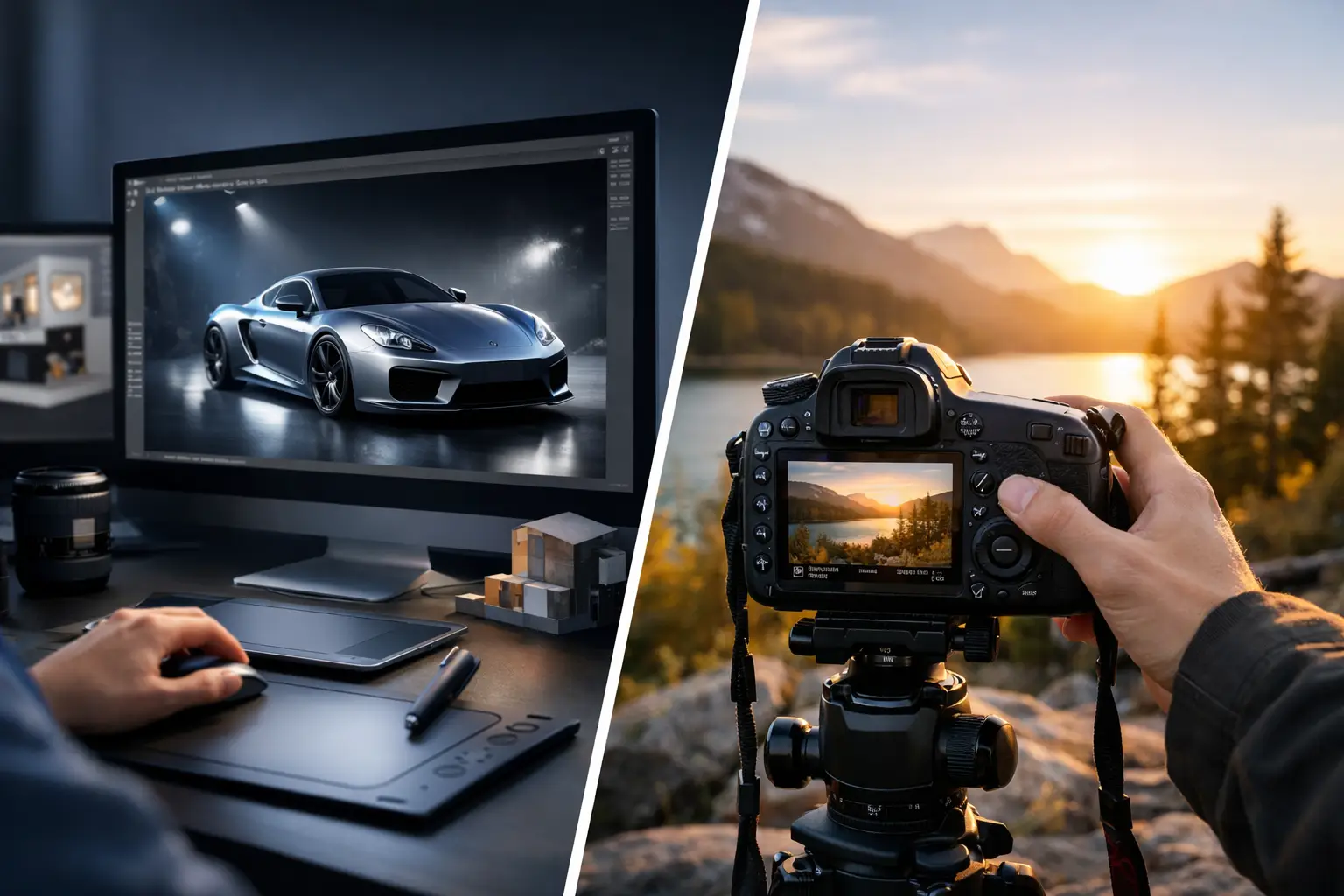
CGI Versus Photography: Which Works Best?
A property brochure is ready to go to print, but the building is still a construction site. A product campaign needs a new colourway, but the sample has not arrived. These are the moments when the CGI versus photography decision becomes commercial rather than purely creative. Both can produce persuasive, premium imagery, but they solve different problems.
For developers, architects, marketing teams and consumer brands, the right choice depends on what must be shown, when it needs to be available and how long the assets need to work. Photography captures what exists. CGI visualises what is planned, possible or difficult to stage. The strongest campaigns often use both with purpose.
CGI versus photography: the practical difference
Photography records a real subject in a real moment. It is especially valuable where authenticity, material detail, atmosphere and human interaction are central to the message. A completed development, a hospitality space at its best, or a product with a distinctive tactile finish can benefit from the credibility that comes from a well-directed shoot.
CGI is built from a digital model and composed to show a subject exactly as required. An image can be created before a scheme is built, before landscaping matures or before a product reaches manufacture. Camera position, lighting, weather, styling and surrounding context are controlled rather than left to location conditions.
That control is not simply a technical advantage. It gives marketing teams the ability to make deliberate choices about the story each image tells. A residential exterior can show the right time of day, an interior can be styled for a clearly defined buyer profile, and a product can appear in multiple finishes without repeatedly arranging studio shoots.
Neither route is automatically better. The question is whether the campaign needs to document reality or communicate a proposition that reality cannot yet provide.
When photography is the right investment
Photography is often the best option once a space, product or project is complete and visually ready. It brings natural variation that can be hard to replicate: the grain of a timber surface, the subtle wear of a material, changing daylight across a façade and the energy of people using a place.
For estate agents, operators and brands with finished environments, professional photography can establish trust quickly. Buyers and customers want reassurance that the experience being presented is genuine. Carefully art-directed photographs can provide that evidence while still feeling aspirational.
Photography also works well for editorial content, social media and campaign moments where spontaneity matters. A real chef in a restaurant, a team at work in a completed office or a family enjoying a landscaped communal area can add a human quality that makes a brand feel tangible.
However, the apparent simplicity of a shoot can conceal practical constraints. Access, weather, site readiness, styling, travel, permits and post-production all affect the timetable. A single overlooked detail – temporary fencing, unfinished paving or the wrong parked car – can weaken an otherwise strong image. Retouching can resolve some issues, but extensive changes may be more costly and less flexible than commissioning CGI from the outset.
Where CGI creates a commercial advantage
CGI earns its place when the asset needs to exist before the physical subject does. For off-plan property marketing, this is fundamental. Buyers need to understand the exterior character, interior finish, views, amenities and lifestyle of a development long before practical completion.
Architectural visualisation also helps teams communicate design intent to planners, investors and stakeholders. A well-composed render can clarify scale, materials, massing and the relationship between a building and its surroundings. It turns technical information into a visual that non-specialists can assess with confidence.
For product brands, CGI provides consistency at scale. Once an accurate model has been created, it can support product launches across packaging, brochures, point of sale, web imagery, animation and social content. New backgrounds, camera angles and colour options can be produced without starting from scratch every time.
The value is particularly clear when variables are likely to change. If a developer updates a kitchen specification, a CGI image can be amended to reflect it. If a brand launches in three markets, the same product can be placed in locally relevant settings. This flexibility protects campaign quality while reducing the need for repeated production days.
High-quality CGI must still be grounded in accuracy. Dimensions, finishes, lighting behaviour and context need close attention, particularly where imagery supports a sale or investment decision. Photorealism is not achieved by adding detail indiscriminately. It comes from thoughtful composition, credible materials and a precise understanding of how the finished subject will be experienced.
Cost, speed and control are connected
Clients often ask whether CGI is cheaper than photography. The honest answer is that it depends on the brief. A straightforward shoot of a finished space may be more economical than creating a detailed digital model. Conversely, photographing an unfinished, inaccessible or frequently changing subject can become expensive quickly, especially when styling, travel, reshoots and extensive retouching are included.
CGI has an upfront production cost because the model, scene and materials must be developed. That investment can become more efficient when several images, angles, variants or campaign formats are needed. A single set of approved assets can create a foundation for stills, animations, virtual tours and printed marketing collateral.
Speed also depends on what is already available. Photography can be quick if the location is complete, accessible and shoot-ready. CGI can be quicker if a project is months from completion but has reliable architectural drawings, specifications and a clear design direction. In both cases, decisive approvals and well-organised source material make the greatest difference to delivery.
The most useful comparison is not the price of one image against another. It is the total cost of getting campaign-ready visuals that remain accurate, on-brand and usable across every required channel.
Choosing the format for property and architectural marketing
Property campaigns rarely need an either-or answer. CGI is typically the lead medium during planning, launch and construction, when it can create exterior views, interior scenes, site plans, floor plans and virtual staging. Photography becomes increasingly valuable as show homes, amenities and completed phases are available to capture.
Using both creates a clearer customer journey. Early CGI establishes the vision and supports off-plan sales. Later photography validates the finished result, gives social channels fresh material and adds the lived-in proof that purchasers want as handover approaches.
Consistency is essential when the campaign includes brochures, hoarding, sales-suite displays, digital advertising and presentation material. If visual assets are commissioned separately without a shared creative direction, they can feel disconnected. The architecture may be presented in one tone, the interiors in another and the brand collateral in a third.
A coordinated studio approach avoids that drift. At TDR Creative, CGI visualisation and graphic design are planned as connected parts of the same commercial story, so imagery, layouts, typography and print outputs reinforce one another. This is particularly useful for developments that need to launch confidently while design and construction programmes continue to move.
A better brief produces better imagery
Whether commissioning CGI or photography, start with the commercial purpose rather than the output alone. Define the audience, the channels, the key selling points and the decisions the visual needs to support. An investor presentation may need clarity and credibility. A luxury residential campaign may need emotional appeal, material quality and a sense of lifestyle. A product launch may need precise detail and adaptable assets.
It also helps to confirm what must be accurate and what can be creatively interpreted. In property imagery, fixed design elements, views and specifications should be agreed early. In lifestyle scenes, furniture, lighting and styling can be used more flexibly to make the proposition feel desirable without misrepresenting the offer.
Finally, consider future use before commissioning the first asset. Ask whether the imagery will need landscape and portrait crops, print-ready files, motion content, alternate finishes or updates at later project stages. Planning these requirements early creates better value and avoids compromises when the campaign expands.
The best visual choice is the one that makes the next commercial decision easier. Use photography when the real world is ready to sell. Use CGI when the vision needs to be seen, refined and marketed before it exists – and bring the two together when the campaign needs both aspiration and proof.
Transform the way you present your developments. Our high‑end CGI and visualisation services help buyers understand your vision long before construction begins. If you’re planning a new project, we can support you from concept to full marketing rollout.
Contact us and book a bespoke quotation → https://tdrcreative.co.uk/contact-the-drawing-room/ Browse our CGI portfolio → https://tdrcreative.co.uk/3d-creative-visuals/ Call us 0121 666 7446
