Home » What Are CGI Stills in Property Marketing?
What Are CGI Stills in Property Marketing?
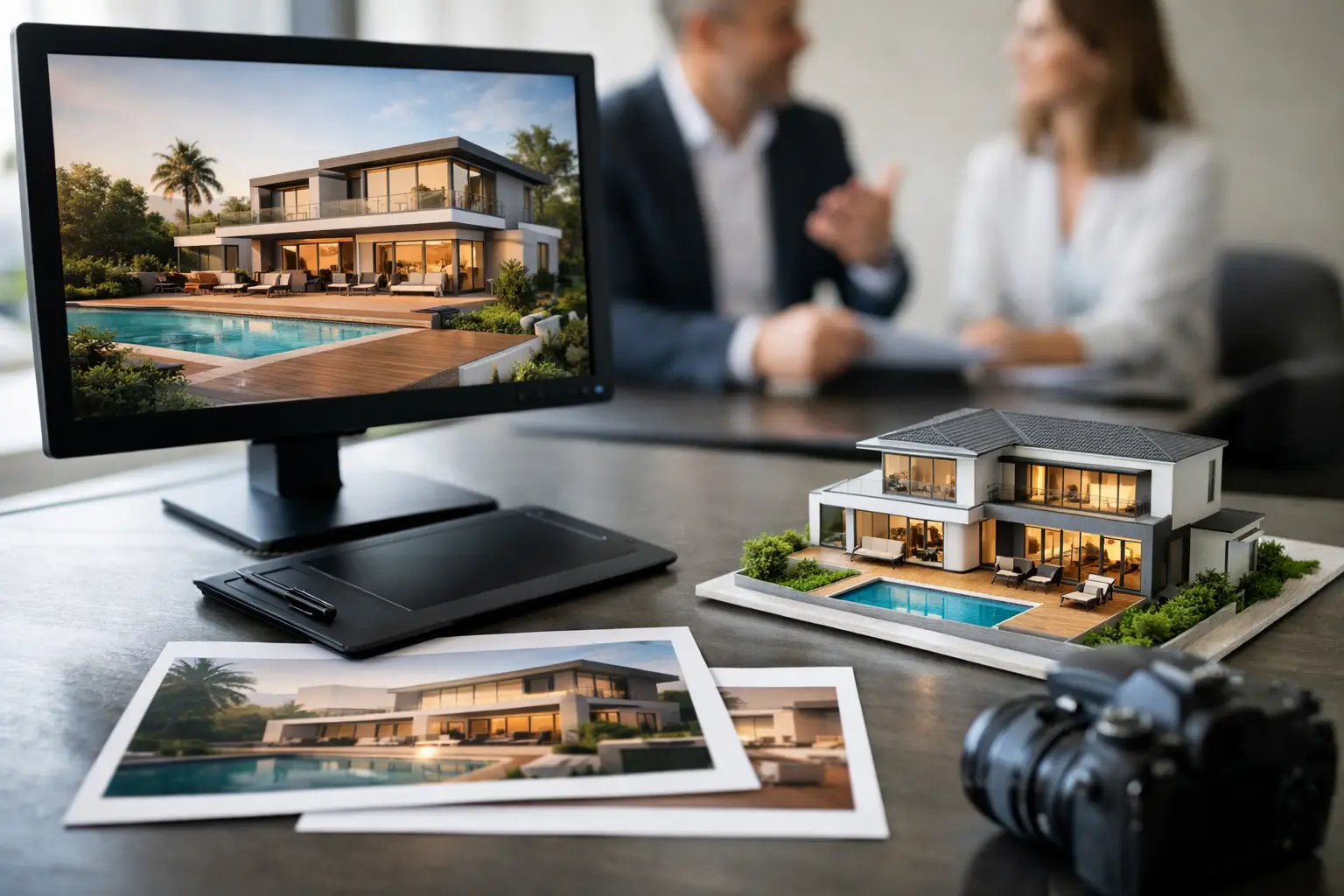
A development does not need to be complete before it needs to sell. For property marketers, architects and brand teams, that creates a clear challenge: how do you present a space, product or idea convincingly when it exists only in drawings, specifications or early-stage plans? What are CGI stills? They are the high-quality, computer-generated images that turn those plans into persuasive visual assets.
Unlike a simple technical drawing, a CGI still is designed to communicate atmosphere as well as information. It can show the quality of a kitchen, the scale of a new neighbourhood, the materiality of a façade or the potential of an unfurnished room – all before construction, manufacturing or installation is complete.
What are CGI stills?
CGI stands for computer-generated imagery. A CGI still is a single, fixed image created using specialist 3D software. It is built from digital models, architectural drawings, product data, material references and lighting decisions, then rendered to produce a photorealistic result.
For a residential scheme, that might mean an exterior image showing a proposed block of flats in its streetscape, with accurate brickwork, landscaping, vehicles and people. For an interior, it could be a carefully styled living room that helps prospective buyers understand room proportions, natural light and the standard of finish. For a consumer brand, it may be a product image created before photography is possible, or one that would be difficult and costly to shoot conventionally.
The word still matters. The output is a static visual rather than an animation, film or interactive tour. That makes CGI stills particularly versatile: they can be used in brochures, hoardings, sales suites, planning presentations, websites, social campaigns, press materials and point-of-sale displays.
Why CGI stills carry commercial weight
A strong visual does more than make a proposal look attractive. It reduces uncertainty. Buyers, investors, planning stakeholders and customers rarely interpret plans in the same way as the professionals who commission them. A well-crafted CGI gives them a more immediate understanding of what is being proposed.
For off-plan property marketing, this can be decisive. A buyer may be choosing a home months or years before completion. They need to picture the view from the balcony, the character of shared spaces and how a particular flat could feel once furnished. Exterior CGI establishes the development’s presence and identity; interior CGI translates specifications into a lifestyle proposition.
The same principle applies to architecture and placemaking. An image can demonstrate how a building relates to neighbouring homes, public realm, planting and pedestrian routes. It can help a design team explain intent without asking an audience to decode elevations and massing studies.
For brands, CGI stills offer a controlled environment. Packaging, product finishes, seasonal backdrops and lighting can be refined without the practical limitations of a studio shoot. A single approved 3D model can also be adapted for multiple viewpoints, colourways and campaign formats, supporting consistency across the marketing mix.
The difference between a CGI still and a photograph
Both aim to tell a visual story, but they begin at different points. Photography records something that already exists. CGI creates a credible representation of something that may not yet exist, may be incomplete or may need to appear in several versions.
That does not mean CGI is automatically the best choice. If a finished product, space or building is available and the brief calls for authentic documentary detail, photography may be more appropriate. Equally, a campaign may combine both: CGI for pre-launch work and photography once the development or product is complete.
CGI becomes especially valuable where changes are likely. If a client needs to test alternative cladding, revise a landscaping strategy, update furniture packages or create imagery for different unit types, digital visualisation can be more efficient than repeatedly staging and photographing physical environments. The trade-off is that CGI depends on accurate source information and a considered approval process. A beautiful image cannot compensate for an incorrect plan, finish or product detail.
What makes a CGI still believable?
Photorealism is not simply a matter of adding more detail. The most convincing CGI stills are built on disciplined decisions about scale, composition, materials, light and context.
Accurate modelling and specification
The building, room or product needs to be modelled to the right level of detail for its intended use. At an early concept stage, this may mean communicating massing, design language and key materials. For a sales brochure or large-format hoarding, finer details such as joinery, ironmongery, façade joints and planting can have a much greater influence on credibility.
Material references are equally important. Brick, timber, stone, metal and fabric behave differently under light. A good visualisation artist does not apply a generic texture and stop there; they consider reflectivity, texture, variation, weathering and how the material sits alongside those around it.
Lighting, camera and composition
Lighting sets the mood, but it must also support the message. A bright daytime exterior may show architecture and landscape clearly, while a dusk image can communicate warmth, occupation and a premium atmosphere. Neither is universally better. The right choice depends on where the image will appear and what it needs to achieve.
Camera position is a strategic decision too. A low angle can give a development a confident presence, but may overstate its scale. A wider view may explain a site’s setting, while a tighter crop can focus attention on an entrance, balcony or feature space. The most effective image balances visual impact with a fair representation of the proposal.
Styling and human detail
Furniture, accessories, people and surrounding activity bring scale and life to an image. They should support the target audience rather than distract from the core offer. A family housing development, a city-centre rental scheme and a high-end retirement community require different styling choices because they are selling different experiences.
This is where the combination of CGI and graphic design is useful. Imagery should not be developed in isolation from the brochure, brand identity, floor plans or sales materials it will sit alongside. Consistent typography, colour, messaging and image treatment create a more assured campaign.
From drawings to final image
The production process usually starts with a briefing conversation and a review of available information. Architectural plans, elevations, CAD files, finish schedules, landscaping proposals, product specifications, site photography and brand guidelines all help establish the visual direction.
The CGI team then develops the 3D scene, agrees viewpoints and creates initial previews. This stage is valuable because it allows the client to check the architecture, layout, camera angle and major finishes before final rendering begins. Revisions are normal, particularly where a project is evolving, but they are far easier to manage when feedback is consolidated and clearly prioritised.
Once the scene is approved, lighting, materials, styling and contextual detail are refined. The final render is produced at a resolution suited to its end use, whether that is a digital campaign, printed brochure, exhibition graphic or large-format site signage. Post-production may then enhance sky, vegetation, people and overall colour balance while retaining the integrity of the proposed design.
Briefing a CGI project effectively
The strongest outcomes begin with a brief that connects visual requirements to a commercial purpose. Rather than asking only for ‘three exterior images’, define who needs to be persuaded and what each image should communicate.
A launch image may need to establish the development’s identity from the street. A sales image may need to focus on the kitchen-diner that differentiates a particular home. A planning visual may need to show context and material accuracy with greater restraint. These are different jobs, even when they portray the same scheme.
It also helps to agree practical parameters early: required delivery dates, intended formats, target image sizes, approval contacts and the number of revision rounds. Supply the latest drawings and schedules, and flag elements that remain provisional. This protects both the quality of the image and the efficiency of the programme.
Choosing the right level of CGI
Not every project needs the same degree of detail. A concept visual for an internal stakeholder meeting can be produced differently from a hero image for a national campaign. Budget, timeline, level of design certainty and final display size should all influence the approach.
A cost-effective CGI service should not mean cutting corners on the elements that viewers notice most. It means applying effort where it creates value: clear composition, accurate key finishes, appropriate styling and professional final artwork. For a multi-phase development, building a reusable 3D model can also create longer-term efficiencies as new plots, interiors and marketing materials are released.
At TDR Creative, CGI stills can be planned alongside brochures, floor plans, branding and print materials, helping development and marketing teams maintain one coherent visual standard from the first launch image to the finished sales collateral.
A well-chosen CGI still gives people something concrete to respond to before the physical world catches up. When the image is accurate, considered and made for its audience, it does not merely illustrate a proposal – it helps move a decision forward.
